

In this article
Batana oil and macadamia oil can both soften dry hair, but they do not create the same experience. Batana usually makes more sense when your hair needs a richer pre-wash treatment. Macadamia oil often suits people who want easier spread and a softer finish with less of a coated feel.
Neither oil is automatically better. The stronger match depends on how your hair responds to weight, where you apply the oil, and how easily shampoo removes it. A dense oil can feel elegant on coarse curls and excessive on fine strands.
Judge both oils after washing and drying, not while the hair is freshly coated. Immediate gloss only shows that oil is present. It does not tell you whether the hair will stay soft, fall flat, or hold residue.
Key Takeaways
-
Batana usually suits richer pre-wash care for coarse, dry, or curly hair.
-
Macadamia often spreads more easily when you want softness with less coating.
-
Product format and dosage can change how either oil feels on hair.
-
Neither oil has strong clinical evidence for hair regrowth.
Batana Oil vs Macadamia Oil at a Glance
Both are lipid-rich plant oils, but chemistry alone cannot predict the finish. Macadamia oil is high in monounsaturated fatty acids, especially oleic and palmitoleic acids. A comparative analysis of macadamia oils also found variation among cultivars, so one bottle may not behave exactly like another.
Raw batana is commonly sold as a dense or buttery oil, while macadamia is usually a pourable liquid. Formulated products can blur that contrast. A batana blend may feel fast-spreading, while a macadamia product may include other oils or silicones that leave more coating.
|
Comparison Point |
Batana Oil |
Macadamia Oil |
|
Typical form |
Rich, dense, sometimes semi-solid |
Fluid and easy to pour |
|
Spread |
Needs careful distribution |
Usually spreads quickly |
|
Strand weight |
More noticeable when overapplied |
Often lighter in small amounts |
|
Finish |
Cushioned and richly conditioned |
Soft, smooth, and polished |
|
Washout effort |
May need more thorough shampooing |
Often easier to remove |
|
Best starting use |
Pre-wash treatment on dry lengths |
Light finishing or shorter pre-wash care |
|
Likely fit |
Coarse, curly, coily, porous, or very dry hair |
Fine to medium hair or residue-sensitive routines |
|
Main drawback |
Can flatten or coat hair |
Can grease roots or feel thin on dry ends |
Hair porosity, density, climate, shampoo strength, and dosage can change the result. For a broader category comparison, Keyoma explains how hair oil differs from serum.
How They Differ in Texture, Weight, and Finish
The useful comparison is how each oil behaves from application through the next wash. Texture controls distribution. Weight affects volume and movement. Washability determines whether softness turns into buildup.
Texture and Spread
Raw batana often softens when warmed between the palms, then clings to the strands. Trichologist Hannah Gaboardi describes its thick, buttery consistency as better suited to thick, curly, or coily hair than fine or oily hair. The density also makes targeted application easier on rough areas.
Macadamia oil usually moves faster across the hands and hair. Even distribution is easier, but overapplication can remain hidden until the hair dries. A fluid oil is not automatically lightweight.
Strand Weight and Softness
Batana tends to create a cushioned feel on dry lengths, especially after frequent shampooing, chemical processing, or friction. It fits hair that needs substance rather than shine alone.
Macadamia often gives a silkier first touch and may preserve more movement when used sparingly. On coarse or porous ends, though, it may feel too light. Choose batana for a richer buffer and macadamia for smoother movement.
Softness is not permanent repair. Oils can improve lubrication, shine, manageability, and resistance to friction, but they cannot fuse split ends. Keyoma’s guide to oils for split ends separates temporary conditioning from damage that needs trimming.
Washability and Buildup
The real test starts in the shower. If one normal shampoo leaves the hair soft and mobile, the amount was likely close to right. Waxy lengths, separated shiny sections, or limp roots after drying point toward excess oil.
Batana may need more deliberate cleansing on low-density or low-porosity hair. Macadamia often rinses more easily, but repeated leave-in use can still create a film. Before reaching for harsher shampoo, reduce the amount, keep oil below the ears, or move it to a pre-wash role.
Keyoma’s review of the side effects of hair oiling covers greasy roots, irritation, and residue in more depth.
Which Oil Better Fits Your Hair?
Hair type labels help, but your response to weight gives better guidance. Two people with curls can need opposite oils if one has dense, porous strands and the other has fine, low-density hair.
Fine, Straight, or Easily Weighed-Down Hair
Macadamia is the safer first test when your hair loses volume quickly. Keep it on the ends, use the smallest workable amount, and wait until the hair is fully dry before judging it.
Batana is not off-limits. Use it as a targeted pre-wash treatment on rough ends rather than a scalp-to-tip coating. A formulated batana blend may also feel lighter than raw batana.
Thick, Coarse, Curly, or Very Dry Hair
Batana often earns the stronger role because dense, dry strands can handle more coating without losing movement. Apply it to zones that rub together, tangle, or stay rough after conditioner instead of saturating every curl.
Readers considering batana oil for dry hair should still start small. Coarse strands may tolerate weight while the scalp does not. Macadamia can serve as a lighter refresh between richer treatments.
Damaged Ends and High-Friction Routines
Bleached ends, tight curls, frequent detangling, rough collars, and repeated heat styling increase friction. Either oil can improve slip. Batana usually gives more cushioning, while macadamia often leaves a cleaner finish.
A controlled study of coconut, sunflower, and mineral oils found that the oils did not behave identically in hair. Coconut reduced protein loss, while the other tested oils did not. Those findings cannot be transferred to batana or macadamia, but they show why a fatty-acid list is not proof of penetration or repair.
Plain cosmetic oil should not replace a tested heat protectant. Use a product specifically labeled for heat styling.
Can I Use Both?
Yes, but you do not need to layer them together. Assign each oil a job. Use batana before washing when the lengths feel rough, then reserve macadamia for a small finishing touch on dry ends. Alternating them on separate wash days also makes comparison easier.
Mixing them immediately hides useful feedback. If the hair feels heavy, you will not know which oil or ratio caused it. Test them separately before combining a small amount.
Frequency should follow your washout results rather than a fixed calendar. Keyoma’s advice on hair oiling frequency considers scalp oiliness, strand dryness, and buildup.
How to Use Both Oils Without Overloading Hair
Treat the first applications as a controlled comparison. Keep your shampoo, conditioner, styling method, and drying method the same. Change only the oil.
Test One Section Before Full Application
Choose two small sections with similar dryness. Apply batana to one and macadamia to the other. Compare spread, shampoo removal, dry feel, and next-day movement.
The smallest effective amount varies by length, density, and formula. Keyoma’s guidance on how much batana oil to use offers a more useful starting point than a fixed drop count.
Give Batana the Richer Pre-Wash Role
Warm a small amount between your palms, press it into dry mid-lengths and ends, and distribute it with your fingers. Add more only where the hair still feels rough.
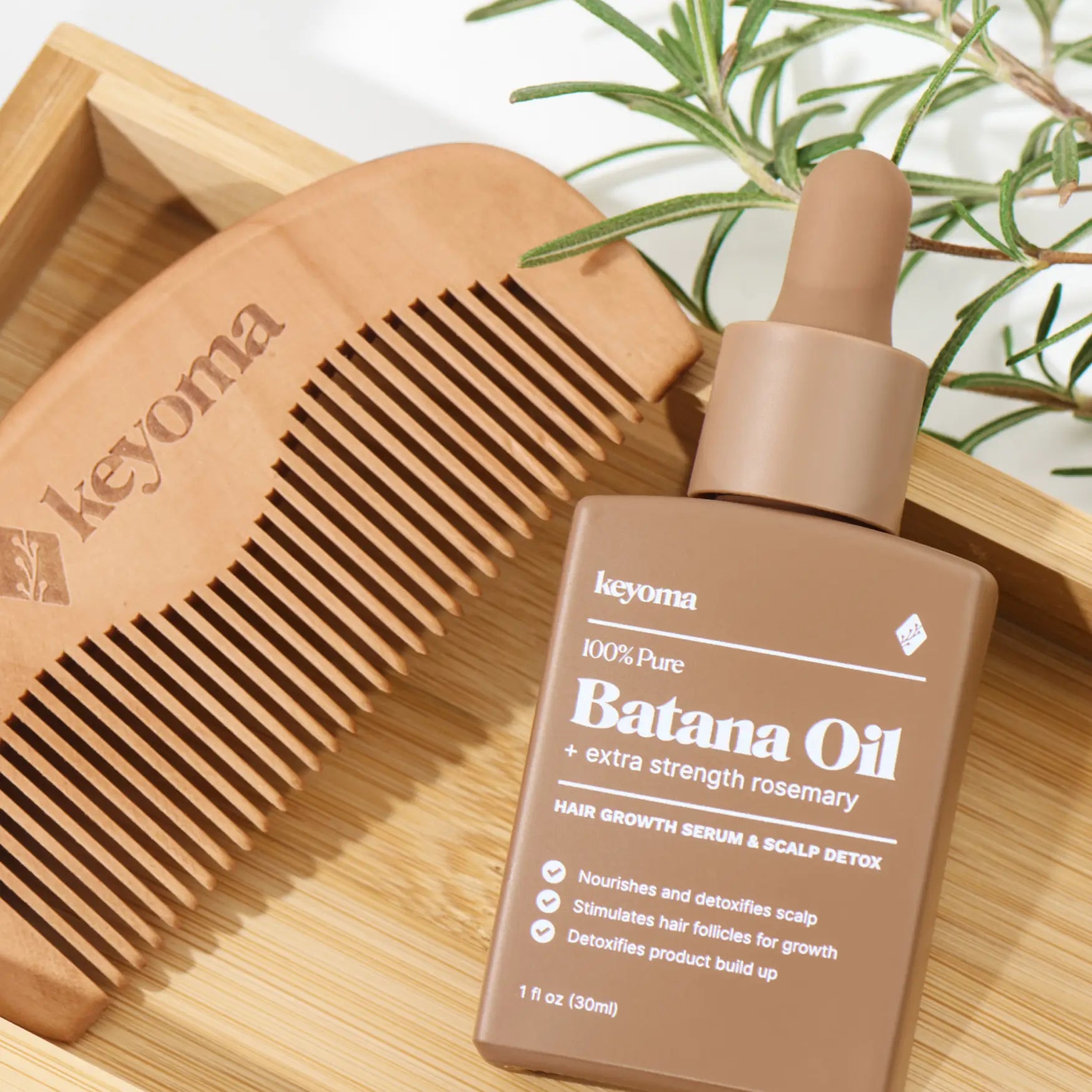
A finished blend may behave differently from raw oil. Keyoma Pure Batana Oil with Rosemary combines batana and rosemary in one formula, so judge its spread and washout on their own rather than assuming it represents every batana product.
Keep Macadamia for Lighter Finishing
After the hair is dry, smooth a small amount across the ends and outer layer. Stop before strands gather into shiny pieces. Fine hair may need only the residue left on the palms.
Do not use plain macadamia oil before a hot tool as a substitute for heat protectant. Apply oil afterward only when the finish needs more softness.
Adjust by Washout and Next-Day Feel
Reduce the dose or move application lower when roots look flat, hair attracts lint, or lengths stay slick after shampooing. A useful oil should make hair easier to handle without forcing aggressive cleansing.
The American Academy of Dermatology’s product-testing method recommends testing a small area and watching for redness, itching, or swelling before wider use.
People with a known macadamia or tree nut allergy should not assume all cosmetic oils carry the same risk. Refining can remove much of the allergenic protein, while unrefined oils may retain more. Anaphylaxis UK’s plant-oil guidance recommends caution when the processing method is unclear.
Choose Batana Oil vs Macadamia Oil for the Right Finish
Choose batana when your hair needs a richer buffer before washing, especially on coarse, curly, porous, or persistently dry lengths. Choose macadamia when movement and a softer surface finish matter more than a dense coating.
A controlled section test gives the clearest answer. Compare the oils after shampooing, drying, and sleeping on the result. The better match leaves hair softer and easier to handle without flattening it, irritating the scalp, or making the next wash harder.
Featured Product
30% Off + 3 FREE Gifts
100% Pure Batana Oil + Rosemary


