

In this article
Batana oil and meadowfoam seed oil can both make hair feel softer and look shinier, but they take different routes to that finish.
Batana oil is the more natural starting point when dry, coarse, porous, or textured hair needs a richer conditioning layer. Meadowfoam seed oil may be easier to work into lightweight finishing products because it spreads smoothly and resists oxidation particularly well.
That does not make one oil universally more moisturizing or shinier than the other. Your strand thickness, current damage, application method, and dose can change the result more than the ingredient name alone.
Key Takeaways
-
Batana oil generally suits dry, coarse, textured, porous, or weathered lengths that respond well to richer conditioning.
-
Meadowfoam seed oil is known for its silky spread, long-chain fatty-acid profile, and strong oxidative stability.
-
Neither oil adds water to hair. Apply oil after water or a water-based conditioner when moisture retention is the goal.
-
The best choice depends on how your hair looks several hours after application, not only how smooth it feels immediately.
Batana Oil vs Meadowfoam Seed Oil at a Glance
|
Factor |
Batana Oil |
Meadowfoam Seed Oil |
|
General feel |
Richer and more substantial |
Silky and easy to distribute |
|
Best starting point |
Dry, coarse, curly, coily, porous, or weathered hair |
Fine-to-medium strands and lightweight finishing formulas |
|
Type of shine |
Rich, conditioned-looking finish |
Smooth, polished surface finish |
|
Moisture role |
Helps seal in moisture and soften rough-feeling lengths |
Coats the surface and helps limit moisture loss |
|
Oxidative stability |
Varies with processing, storage, and formulation |
Notably resistant to oxidation |
|
Main overuse risk |
Greasiness, buildup, or reduced definition |
Limpness, separation, or residue |
|
Common routine role |
Pre-wash treatment or controlled sealing step |
Finishing oil, emollient, or ingredient in a blended formula |
These are practical tendencies rather than fixed scientific rankings. A highly refined batana blend may feel lighter than a poorly dosed meadowfoam oil. Added silicones, other botanical oils, fragrance, extraction methods, and applicators can also change how a finished product behaves.
How Hair Oils Support Moisture Without Adding Water
The word “moisturizing” can make an oil sound as though it hydrates dry hair on its own. It does not.
A pure oil contains little to no water. What it can do is coat the strand, improve lubrication, reduce friction, and slow some moisture loss after hair has already been wetted or conditioned. This is why oil usually works better as the last part of a moisturizing sequence than as the entire sequence.
Think of the difference this way:
-
Water supplies moisture.
-
Conditioner helps soften and manage the strand.
-
Oil can help preserve that softness and improve the surface feel.
If your hair feels dry because it has not received enough water or conditioner, adding more oil can create a misleading result. The surface may feel slick while the strand underneath remains stiff or brittle. As layers accumulate, the hair can eventually look dull instead of glossy.
Evidence for botanical oils also varies widely. A systematic review of coconut, castor, and argan oils found that the strength and type of evidence were different for each oil. That is a useful reminder not to transfer a benefit demonstrated for one plant oil directly to batana or meadowfoam.
Which Oil Feels Lighter on Hair?
Meadowfoam seed oil is often described as the lighter or silkier option, while batana oil is treated as the heavier one. That description is useful as a starting point, but oil weight is not determined by viscosity alone.
What you perceive as “heavy” depends on several factors:
-
How many drops you use
-
How far the oil spreads
-
Your strand diameter
-
Existing product buildup
-
Whether your hair is damp or dry
-
Where you place the oil
-
Whether it is pure or part of a formula
-
How long it remains on the hair
Fine strands show excess coating quickly because there is less surface area and structure to support it. Coarse or highly textured hair may accept the same amount without appearing flat, especially when the ends are porous or weathered.
The real test is not how the oil feels between your fingers. It is whether your hair maintains movement, separation, and volume after the oil settles.
When Batana Oil’s Richer Feel Helps
Batana oil makes the most sense when your ends still feel rough after conditioning or when a very light finishing oil seems to disappear without improving manageability.
Its richer coating may suit:
-
Coarse or thick strands
-
Curly and coily hair
-
High-porosity lengths
-
Bleached or chemically weathered ends
-
Hair exposed to frequent friction
-
Pre-shampoo treatments
-
Small sealing applications over leave-in conditioner
The aim is not to saturate the hair. It is to place a controlled amount where roughness and friction are most noticeable.
For a pre-wash application, distribute a small amount through dry mid-lengths and ends before shampooing. For sealing, warm a minimal amount between your palms and press it over damp, conditioned ends. These methods give batana oil a defined job instead of allowing it to become another undirected layer.
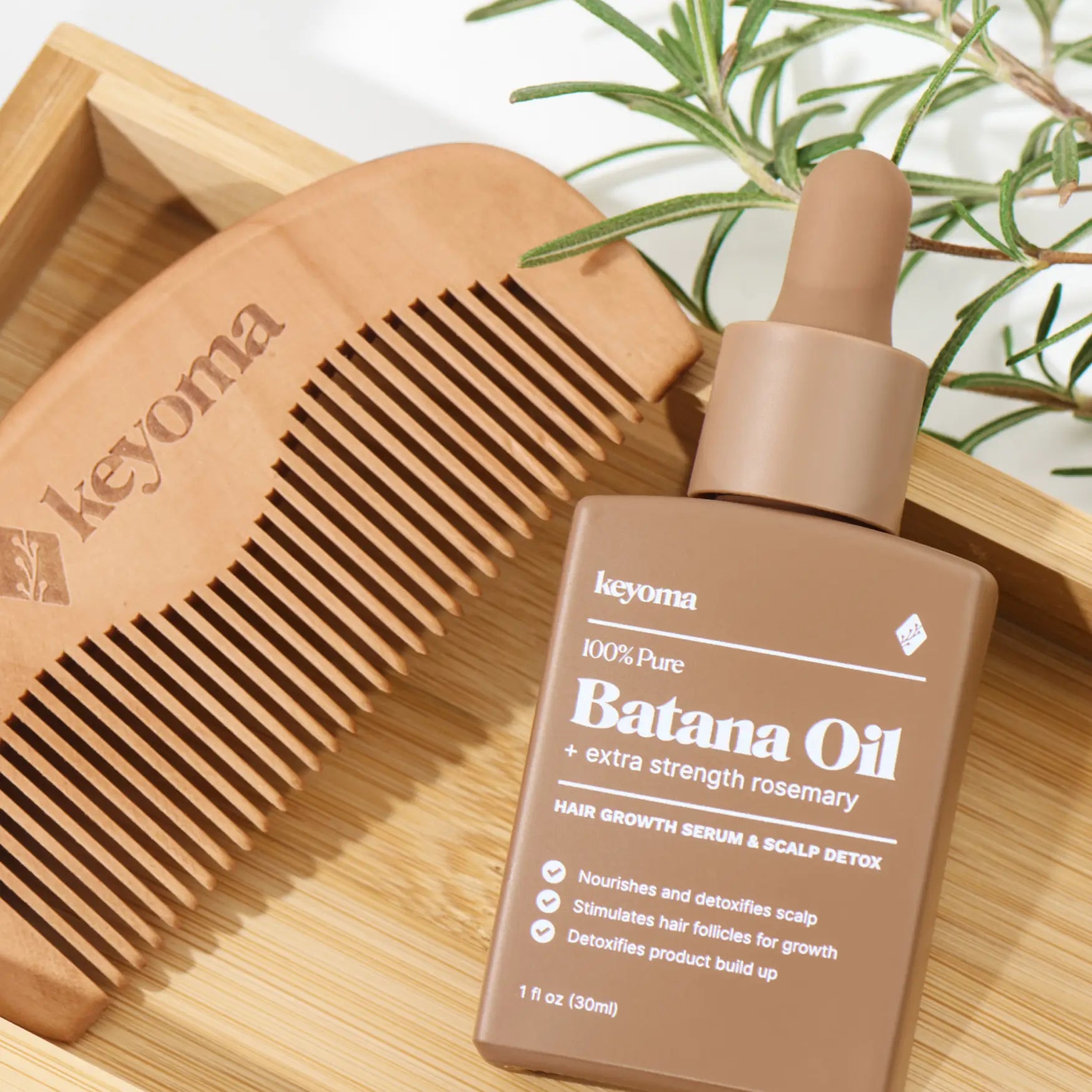
If this richer conditioning profile matches your needs, Keyoma’s Pure Batana Oil with Rosemary Oil offers a focused option for incorporating batana into your routine. Because it is a batana and rosemary formula rather than plain batana alone, evaluate the complete ingredient combination and patch-test it before broader use.
When Meadowfoam Seed Oil May Work Better
Meadowfoam seed oil may be a better starting point when your hair loses volume easily or you want a thin polishing layer rather than a substantial oil treatment.
It is especially relevant for:
-
Fine-to-medium strands
-
Straight or loosely wavy hair
-
Dry ends that need slip but not saturation
-
Lightweight finishing oils
-
Serums and multi-ingredient formulas
-
Routines in which spreadability matters
-
Products stored for extended periods
Its composition also makes meadowfoam valuable to formulators. According to Elementis’ meadowfoam seed oil technical overview, the oil consists largely of long-chain fatty acids and is notably resistant to oxidation. This makes it useful in hair-conditioning and styling products where formula stability matters.
However, a stable oil is not automatically a weightless oil. Fine hair can still look separated or limp if the application exceeds what the strands can hold.
Which Oil Gives Hair More Shine?
Shine is not simply a nutrient that an oil deposits into hair. It is an optical effect influenced by how evenly the strand’s surface reflects light.
Hair tends to look shinier when the cuticle surface is smoother, strands are aligned, and residue is distributed in a thin, even layer. Roughness, severe weathering, frizz, mineral deposits, and excess product can interrupt that reflection.
Batana and meadowfoam may support two slightly different visual outcomes.
Batana Oil Can Create Richness-Driven Shine
On dry or coarse hair, a richer coating can soften the appearance of roughness and give the lengths a deeper, more conditioned look. Batana oil may therefore produce more noticeable shine on hair that looks faded or chalky when it lacks surface lubrication.
But dose is critical. Too much can make sections clump together, darken unevenly, or appear greasy at the roots while the ends remain dry.
Meadowfoam Can Create a Polished Surface Finish
Meadowfoam seed oil’s smooth spread can make it easier to create a thin polishing layer. This may suit hair that already has reasonable softness but needs a cleaner-looking finish over flyaways or dry ends.
That polished effect is not proof that the oil repaired the cuticle. It means the surface has been temporarily conditioned and light is reflecting more evenly.
Neither result is inherently better. Rich shine may look beautiful on dense curls but overpower fine, straight hair. A subtle polished finish may preserve movement on fine strands but feel insufficient on coarse, porous ends.
Test Shine Without Letting First Impressions Decide
The first five minutes after application can be misleading. Freshly oiled hair often looks glossy because the product is still sitting prominently on the surface. The better comparison is how the hair behaves later.
Run a controlled test across two wash days:
-
Use the same shampoo, conditioner, and styling products each time.
-
Apply one oil on the first wash day and the other on the next.
-
Start with one drop or the smallest amount you can distribute evenly.
-
Apply from the ends upward, stopping before the roots.
-
Assess the hair only after it has dried completely.
-
Check shine in natural light rather than under a bright bathroom bulb.
-
Reassess several hours later for volume loss, separation, stiffness, or grease.
-
Note how the hair feels the following morning.
The winner is the oil that improves softness and shine without making you compensate with extra shampoo, dry shampoo, or frequent clarifying.
Why Oxidative Stability Matters, but Not in the Way You May Think
Oxidative stability describes how well an oil resists degradation when exposed to oxygen, heat, and light. As an oil oxidizes, its smell, color, texture, and overall performance may change.
Meadowfoam seed oil is particularly useful in formulation because its unusual fatty-acid structure helps it resist oxidation. This can support shelf stability and help a blended product maintain its expected feel over time.
That advantage should not be confused with superior hair repair. Oxidative stability does not show that meadowfoam penetrates more deeply, moisturizes more intensely, or produces more shine than batana oil. It mainly tells you something about the ingredient’s resistance to degradation.
Batana oil’s stability can vary according to how it was extracted and refined, what other ingredients are present, and how the product is packaged. A finished formula should therefore be judged as a whole.
For either oil:
-
Close the container tightly after use.
-
Keep it away from direct sunlight.
-
Avoid storing it in excessively hot or humid areas.
-
Follow the product’s stated shelf-life instructions.
-
Stop using it if the smell or texture changes significantly.
Choose Batana or Meadowfoam Based on the Job
Instead of asking which oil has the longer list of benefits, decide what you need the product to accomplish.
Choose Batana Oil If
Batana oil is the stronger starting choice if your hair feels rough even after conditioning, particularly when you have coarse, thick, curly, coily, porous, or chemically weathered lengths.
It also makes sense when you want an oil to serve as a defined pre-wash treatment or sealing step. You should still be able to use a small amount without sacrificing movement or curl definition.
Choose Meadowfoam Seed Oil If
Meadowfoam seed oil may fit better if your hair becomes limp easily and you want smooth distribution with a more restrained surface finish.
It is also useful when you are evaluating finished products and value oxidative stability, low odor, or an elegant sensory profile. In this case, meadowfoam may be one supporting ingredient rather than the headline oil.
Consider a Serum Instead If
Neither pure oil may be the best choice when your main goal is immediate gloss, humidity control, or a predictable styling finish.
Serums can combine oils with silicones and other conditioning ingredients to create a more engineered surface effect. They may spread more consistently and require less trial and error than a raw botanical oil.
The practical differences become clearer when comparing hair oil versus a serum, particularly if pure oils repeatedly leave your hair separated, greasy, or flat.
How to Apply Either Oil Without Creating Buildup
A good application begins with clean, conditioned hair and a conservative dose.
If moisture retention is your goal, apply the oil while your lengths are still slightly damp. Water and conditioner provide the moisture and softness. The oil follows as a light surface layer.
Start with one drop for fine or short hair. Rub it thoroughly between your palms until your hands have only a slight sheen. Press your palms against the ends before moving upward. Do not begin at the crown or scalp unless the product was specifically chosen for scalp use.
Let your hair dry before deciding whether you need more. Adding oil while hair is still wet can make it difficult to judge the final weight.
If your hair dries stiff, coated, or stringy, do not assume it needs another layer. The problem may be too much oil, incompatible styling products, or accumulated residue. Reduce the dose during the next application and clarify only as often as your hair and scalp tolerate.
More oil does not produce endlessly increasing shine. After the strand is adequately coated, additional product tends to create separation and visible grease.
Can You Use Batana and Meadowfoam Seed Oil Together?
Batana and meadowfoam seed oil can appear in the same formula or routine, but combining them is not automatically more effective.
A formulator might use meadowfoam seed oil to influence spread, texture, and stability while using batana oil for a richer botanical conditioning profile. The final result depends on the proportions and every other ingredient in the product.
At home, avoid pouring one oil directly into a full bottle of another. This makes dosage less predictable and may change how the original product ages.
If you want to test them together, combine a tiny amount in your palm for immediate use. Apply it to a small section of your ends and observe the result through the following day. If the combination feels heavy, test the oils separately instead of trying to correct the blend with more products.
The Better Oil Is the One Your Hair Can Carry
Batana oil is the stronger starting choice when dry, coarse, textured, porous, or weathered lengths need a richer conditioning layer. Meadowfoam seed oil is more compelling when you prioritize a silky finish, smooth distribution, and oxidative stability.
Neither oil replaces water or a water-based conditioner. Neither permanently repairs damaged hair. And neither will look its best when the dose exceeds what your strands can carry.
Choose based on the finish your hair maintains, not the promises attached to the ingredient. If a small amount of batana oil leaves your ends softer without flattening them, its richer character is an advantage. If meadowfoam gives you polish while preserving movement, its lighter sensory profile may serve you better.
Frequently Asked Questions
Is batana oil heavier than meadowfoam seed oil?
Batana oil is generally perceived as the richer option, while meadowfoam seed oil is valued for its smooth spread and silky finish. Processing, formulation, strand thickness, and application amount can change how heavy either oil feels.
Is meadowfoam seed oil good for fine hair?
Meadowfoam seed oil may suit fine hair when used sparingly, particularly as part of a lightweight finishing formula. Fine strands can still become limp when too much is applied.
Does batana oil moisturize hair?
Batana oil does not add water to hair. It can coat and lubricate strands, help limit moisture loss, and make hair feel softer after water or a water-based conditioner has been applied.
Which oil is better for shiny hair?
Batana oil may create a richer, conditioned-looking shine on coarse or dry hair, while meadowfoam seed oil may provide a smoother polished finish. The better choice depends on strand condition, desired volume, and dose.
Can I apply meadowfoam seed oil to my scalp?
Meadowfoam seed oil can be included in scalp products, but not every scalp tolerates every botanical ingredient. Patch-test it first and stop using it if you experience redness, burning, itching, swelling, or worsening flakes.
Can I use batana oil and meadowfoam seed oil together?
You can combine small amounts of batana and meadowfoam seed oils, but using both is not automatically better. Test the mixture on one section and avoid altering an entire finished product without formulation knowledge.
Featured Product
30% Off + 3 FREE Gifts
100% Pure Batana Oil + Rosemary


