

In this article
Noticing more hair in the shower after starting a GLP-1 medication can make the drug feel like the obvious cause. The connection is not that simple. Hair loss has appeared in weight-management trial data for some GLP-1-based treatments, but researchers have not confirmed one mechanism that explains every case.
For many people, the timing and pattern look more like a delayed response to rapid weight loss, lower food intake, illness, stress, or several triggers occurring together. Others may have pattern hair loss, iron deficiency, a thyroid problem, scalp inflammation, or breakage that became easier to notice during treatment.
The safest response starts with three questions: Is hair shedding from the root or breaking along the length? Is the loss diffuse or patterned? Did it follow a change in weight, appetite, health, or medication?
Key Takeaways
-
GLP-1 hair loss is reported, but its exact cause remains uncertain.
-
Delayed, diffuse shedding may fit telogen effluvium after rapid body changes.
-
Patchy loss, widening areas, pain, or inflammation need closer evaluation.
-
Do not change medication or take supplements without professional guidance.
Can GLP-1 Medications Cause Hair Loss?
Yes, hair loss has been reported during treatment with some GLP-1-based weight-management medications. The current Wegovy prescribing information states that hair-loss reactions in injection trials were associated with weight reduction. Its pooled adult data reported hair loss more often with the 2.4 mg dose than with placebo. The Zepbound prescribing information also links reported hair-loss reactions with weight reduction and notes a higher reporting rate among female participants than male participants in pooled studies.
Those findings confirm that shedding occurred during specific trials. They do not prove that the medication directly changed the follicle, identify which participants had telogen effluvium, or predict what will happen to one person. Trial rates also should not be compared across products as though the studies used the same population, dose, design, or method of recording hair loss.
Wegovy and Ozempic contain semaglutide, while Zepbound and Mounjaro contain tirzepatide, but each product has its own indication and trial program. Do not transfer one label's adverse-event rate to another product.
A 2026 systematic review of GLP-1 therapies and hair loss found an emerging signal across trials, observational studies, and safety databases, while stressing that evidence remains limited. A retrospective cohort study also found an association, but its design cannot establish direct causation.
|
Evidence type |
What it can tell you |
What it cannot prove |
|
FDA clinical-trial data |
Hair loss occurred and was recorded more often in certain treatment groups |
The exact biological cause or your personal risk |
|
Observational studies |
Hair-loss diagnoses may appear more often among GLP-1 users |
That the drug alone caused each case |
|
Spontaneous safety reports |
A repeated concern may deserve further study |
How common the event is without a reliable denominator |
|
Expert and patient experiences |
The timing, appearance, and emotional burden of shedding |
Incidence, diagnosis, or treatment effectiveness |
The defensible conclusion is narrower than “GLP-1 drugs cause baldness.” Medication, weight change, nutrition, health history, and the loss pattern must be considered together.
Why Shedding May Start During GLP-1 Treatment

Shedding usually has more than one possible trigger. During GLP-1 treatment, rapid weight change, reduced food intake, physical stress, and existing health issues may all affect the hair cycle.
Rapid Weight Loss and Telogen Effluvium
Hair follicles do not react to a trigger immediately. A major physical change can shift more follicles into a resting phase, followed by shedding months later. The relevant trigger may predate the dose change you first blamed.
The American Academy of Dermatology describes sudden weight loss as a trigger for excessive shedding and notes that people often notice it a few months after the stressful event. Keyoma’s deeper explanation of how telogen effluvium affects the hair cycle covers the cycle itself without assuming that every GLP-1 user has this condition.
Telogen effluvium usually causes shedding across the scalp rather than one smooth patch. A steadily widening part may point to another condition or overlapping causes.
Reduced Intake and Possible Nutrient Gaps
GLP-1 medications can reduce appetite, and gastrointestinal symptoms can make regular meals harder. Lower food volume does not prove a deficiency. Concern rises when intake stays low, food variety narrows, symptoms persist, or a restrictive diet removes major nutrient sources.
Do not treat hair shedding as proof that you need a supplement. The AAD’s hair-loss diagnosis guidance explains that a dermatologist may use your history, scalp exam, hair-pull findings, blood tests, or a biopsy when the cause is unclear. Testing can separate a suspected deficiency from a normal result and prevent unnecessary high-dose supplementation.
Other Causes That Can Overlap
Timing alone can mislead you. A diffuse shed may expose pattern hair loss that was already developing. Thyroid changes, illness, surgery, hormonal shifts, stress, scalp disease, and other medications can also contribute.
A useful review looks backward across several months, not only to the date you noticed hair on the brush. If fatigue, temperature sensitivity, or other symptoms appear with shedding, review the possible connection between thyroid changes and hair loss with a clinician rather than attributing everything to the injection.
What GLP-1-Related Shedding Usually Looks Like
The pattern can offer useful clues, even though it cannot confirm the cause by itself. Diffuse shedding, patchy loss, widening areas, and breakage often point toward different next steps.
Typical Timing and Diffuse Shedding
Telogen effluvium often has a quiet gap between the trigger and visible shedding. Use this sequence as a map, not a promise.
|
Stage |
What you may notice |
How to interpret it |
|
Trigger period |
Faster weight change, lower intake, illness, stress, or medication changes |
Record the event even if the hair still looks unchanged |
|
Quiet gap |
Little visible difference |
Follicle changes may not appear immediately |
|
Active shedding |
More full-length hairs during washing, brushing, or throughout the day |
Diffuse loss is more consistent with shedding than one isolated patch |
|
Stabilization |
Fewer shed hairs over repeated wash days |
A single good day does not confirm recovery |
|
Visible recovery |
Short regrowing hairs and slowly improving fullness |
Density can lag behind reduced shedding for months |
Take monthly photos with dry hair, similar lighting, the same part, and the same distance. Wet hair, oily roots, or a shifted crown whorl can expose more scalp without proving density changed. Compare the pattern with Keyoma’s explanation of hair shedding and ongoing hair loss.
Signs That Point Beyond Telogen Effluvium
Root shedding and strand breakage can happen at the same time. Full-length hairs point more toward shedding. Short pieces with rough or split ends point toward breakage, especially around friction points or chemically processed sections. Compare the pattern with Keyoma’s visual cues for new growth versus hair breakage.
|
Pattern |
Clues you may see |
Safest next step |
|
Diffuse telogen-effluvium pattern |
Increased full-length shedding across the scalp after a delayed trigger |
Track the timeline and discuss persistent shedding with a clinician |
|
Patterned thinning |
A gradually widening part, receding temples, or crown-focused density loss |
Ask a dermatologist about androgenetic hair loss |
|
Patchy loss |
One or more smooth, sharply defined areas |
Arrange a dermatology assessment rather than waiting for a routine follow-up |
|
Breakage |
Short uneven pieces, frayed ends, knots, or loss concentrated at stressed areas |
Reduce heat, tension, friction, and chemical stress |
|
Inflammatory or scarring signs |
Pain, burning, marked itch, redness, scale, bumps, sores, or shiny areas |
Seek prompt medical evaluation |
A British Association of Dermatologists review of telogen effluvium notes that diffuse shedding can coexist with pattern hair loss. Improvement in shedding does not rule out an underlying density problem if the part or crown keeps widening in consistent photos.
What to Do When Shedding Starts
The first step is not adding more products or changing your medication. Track what changed, protect the hair from extra damage, and bring the pattern and timeline to the right healthcare professional.
Track the Timing, Pattern, and Related Changes
A short record is more useful than saving every strand. Note medication and dose dates, monthly weight trend, appetite, prolonged digestive symptoms, illness, stress, dietary restrictions, scalp symptoms, new medications, and consistent monthly photos.
Do not judge progress from one shower. Wash frequency, detangling, curl pattern, and protective styles change how many loose hairs appear at once.
Contact Your Care Team Before Changing Medication
Do not stop, skip, or reduce a prescribed GLP-1 medication without speaking to the prescriber. They can weigh treatment benefits against your weight trend, symptoms, intake, other medications, and shedding timeline.
A pharmacist can review the current label and possible medication interactions. A dermatologist can examine the scalp and separate diffuse shedding from patterned, autoimmune, inflammatory, or scarring loss. Keyoma’s overview of when to see a doctor for hair loss can help you prepare the details worth bringing to the appointment.
Review Nutrition Without Self-Prescribing Supplements
Bring a realistic food record to a clinician or registered dietitian when appetite or digestive symptoms limit meals. The goal is to find sustained gaps in energy, protein, iron-rich foods, or variety, not chase a “hair vitamin.”
The AAD advises using biotin, iron, or zinc supplements when testing shows a deficiency because excess intake can cause harm. Biotin can also interfere with some laboratory tests. Ask what should be tested before adding a high-dose supplement, and tell your care team what you already take.
Keep Hair and Scalp Care Gentle
Cosmetic care cannot stop telogen effluvium, but it can reduce avoidable breakage. Lower the heat, loosen tight styles, support hair above tangles, and avoid aggressive scalp rubbing.
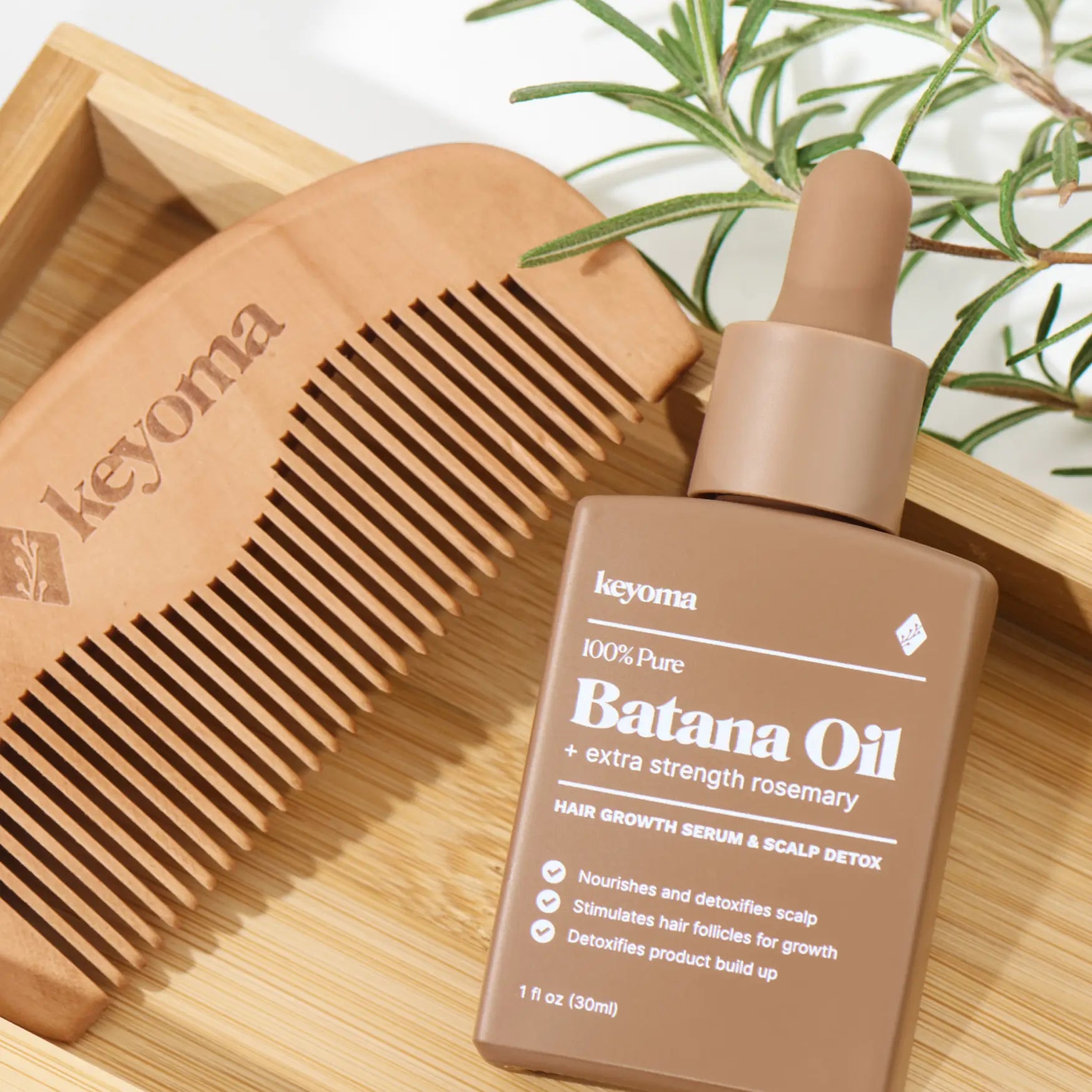
If your mid-lengths and ends need more slip, apply a light film rather than saturating the scalp. Keyoma Pure Batana Oil with Rosemary can serve as a cosmetic conditioning step for softness, slip, and shine. It is not a treatment for GLP-1 hair loss, telogen effluvium, nutrient deficiency, or follicle regrowth.
Stop using a topical product if it causes burning, rash, persistent itch, or worsening scalp discomfort. New scalp symptoms can complicate the picture and deserve evaluation rather than more layering.
Keep application modest and strand-focused. A careful batana oil application method is more suitable than repeatedly coating a sensitive or buildup-prone scalp.
How Long Does GLP-1 Hair Loss Last?
There is no dependable GLP-1-specific recovery clock. With acute telogen effluvium, shedding often settles over several months, while visible fullness takes longer. The AAD describes movement toward previous fullness within six to nine months after readjustment, and the British Association of Dermatologists describes a three-to-six-month shedding phase. Recovery varies.
Seek care sooner for patchy loss, scalp pain, burning, inflammation, sores, eyebrow loss, or rapidly expanding sparse areas. Arrange a review when shedding lasts beyond six months, worsens, or continues after weight and intake stabilize. Waiting alone may miss chronic shedding, pattern loss, or an unresolved trigger.
Manage GLP-1 Hair Loss With a Safer Care Plan
Treat the pattern, timing, and accompanying symptoms as evidence to organize, not as a diagnosis to make at home. Diffuse shedding after major body changes may support telogen effluvium. A widening pattern, isolated patch, inflamed scalp, or heavy breakage points toward a different path and deserves targeted evaluation.
Keep the medication conversation with your prescriber, the diagnostic conversation with a dermatologist, and the nutrition conversation with a qualified clinician or dietitian. Gentle cosmetic care can protect the hair you still have from friction and breakage, but cause-based medical assessment is what determines whether you need testing, monitoring, treatment, or time.
Featured Product
30% Off + 3 FREE Gifts
100% Pure Batana Oil + Rosemary


