

In this article
If hair oil starts burning or stinging your scalp, stop applying it and gently wash it out. Do not assume the sensation means the formula is stimulating your follicles or beginning to work. Persistent or increasing discomfort is a reason to end the treatment.
Burning can happen when a formula irritates your skin, reaches an already-sensitive area, or causes another type of reaction. But the sensation alone cannot tell you whether you have irritation, an allergy, or an unrelated scalp condition.
What matters first is how you respond. Remove the product without adding more irritation, monitor your scalp, and seek medical help if serious warning signs appear.
Key Takeaways
-
Stop using a hair oil if it causes persistent or increasing burning, stinging, or pain.
-
Rinse the oil out with lukewarm water and a gentle cleanser without scrubbing your scalp.
-
Seek prompt medical care for blistering, severe pain, spreading swelling, open skin, eye involvement, fever, or pus.
-
Do not retry the product until your scalp has recovered and you have reviewed what may have triggered the reaction.
What to Do When Hair Oil Starts Burning

You do not need to identify the exact cause before responding. Whether the reaction started immediately or developed after the oil sat on your scalp, the safest first step is to end the exposure.
Stop Applying the Oil
Put the bottle down as soon as the burning begins. Do not apply another layer, massage the product more deeply, or wait for the feeling to become stronger.
Some scalp treatments create a cooling, warming, or tingling sensation because of their ingredients. However, those sensations should never be used as a test of effectiveness. Painful, persistent, or worsening burning is a stop signal.
Avoid scratching or rubbing the uncomfortable area. Friction can further disturb skin that is already irritated and make it harder to judge whether the reaction is settling.
Rinse the Product Out Gently
Use lukewarm water to rinse away as much of the oil as possible. Hot water may feel soothing for a moment, but it can leave sensitive skin feeling drier and more uncomfortable.
If water alone does not remove the product, use a small amount of your usual gentle shampoo. Move your fingertips lightly across the scalp without scratching it with your nails. One careful wash is better than several aggressive rounds of shampooing.
Do not try to neutralize the oil with vinegar, baking soda, rubbing alcohol, essential oils, or a homemade scalp scrub. Adding another active ingredient makes the reaction less predictable and may intensify the discomfort.
Once the oil is out, let your scalp rest. Skip the blow-dryer or use a cool setting directed away from the affected area.
Leave Your Scalp Alone and Monitor It
Pause scalp oils, serums, fragrances, dyes, exfoliating treatments, medicated products you have not been instructed to use, and tight hairstyles. Your normal hair lengths may still need conditioning, but keep new products away from the affected skin.
Check whether the discomfort improves after rinsing or continues to build. Look for redness, swelling, scaling, blisters, or a rash spreading beyond the application area.
Take a clear photo if you can see a change. Save the bottle, packaging, and complete ingredient list. These details can help a dermatologist or another healthcare professional assess the reaction if it does not settle.
Check Whether the Reaction Needs Urgent Care
A mild reaction that improves after the oil is removed is different from one involving rapidly worsening or widespread symptoms. Use the following guide to decide what to do next without trying to diagnose the cause yourself.
|
What You Notice |
What to Do |
|
Brief, mild tingling that stops after removal without a visible reaction |
Do not reapply the product. Continue monitoring your scalp. |
|
Persistent burning, tenderness, redness, itching, scaling, or a worsening rash |
Contact a healthcare professional or dermatologist for guidance. |
|
Blisters, open or raw skin, severe pain, rapidly spreading swelling, pus, fever, or eye involvement |
Seek prompt medical care. |
|
Swelling of the face, lips, tongue, or throat, trouble breathing or swallowing, faintness, or widespread hives |
Seek emergency medical care immediately. |
The American Academy of Dermatology advises seeking immediate emergency care when a rash occurs with breathing or swallowing difficulties or swelling around the eyes or lips. A rash involving most of the body, blistering, open sores, rapid spread, pain, or fever also needs medical attention. Review the academy’s full guidance on when a skin reaction needs medical care.
Why a Hair Oil May Sting or Burn

A burning scalp does not point to one automatic explanation. Products, application habits, and the condition of your skin can all influence how a formula feels.
The Formula Reached an Already-Sensitive Scalp
Skin that is dry, scratched, inflamed, sunburned, or recently exfoliated may sting when a product touches it. The same can happen after bleaching, coloring, tight styling, or using a harsh cleanser.
This helps explain why a familiar oil might suddenly feel uncomfortable even if you previously used it without an obvious problem. Your scalp may be in a different condition during the latest application.
If tightness, small flakes, or sensitivity were present before you applied the oil, review the signs and common triggers of a dry scalp. But do not assume dryness is responsible when the burning is severe, persistent, or accompanied by a spreading rash.
The Product Contains a Concentrated or Irritating Ingredient
A bottle described as hair oil may contain more than one oil. It can also include essential oils, fragrance, preservatives, botanical extracts, or other active ingredients.
Any cosmetic ingredient has the potential to cause a reaction in some people. Fragrance and preservatives are among the common triggers discussed in guidance on contact reactions to cosmetics. Essential oils can also irritate the skin when they are highly concentrated, poorly diluted, or applied to a vulnerable scalp.
This does not mean every aromatic or botanical ingredient is harmful. It means “natural” does not guarantee that every formula will suit every scalp. Concentration, formulation, exposure time, and personal sensitivity all matter.
If your product contained several essential oils, read what to do after a scalp reaction to an essential oil blend.
A Delayed Skin Reaction May Be Developing
Not every reaction begins during application. According to DermNet, allergic contact dermatitis commonly appears 24 to 72 hours after contact and can remain localized or spread beyond the original exposure area. It may also happen after previous use of the ingredient caused no apparent trouble. Read more about the possible timing and presentation of allergic contact dermatitis.
Still, timing does not provide a diagnosis. Irritant and allergic reactions can share symptoms such as redness, itching, tenderness, burning, and stinging. The American Academy of Dermatology includes burning and stinging among the possible signs of contact dermatitis, but a healthcare professional must evaluate the full pattern.
For a more detailed comparison, see how hair oil allergy and irritation can differ.
Review Everything That Touched Your Scalp
The oil may be the most obvious suspect, but it may not be the only new exposure. Reviewing the entire routine can reveal details you would otherwise overlook.
Write down:
-
The exact product and full ingredient list
-
Whether the product was new or recently reformulated
-
How much you applied
-
Whether you mixed it with another oil or treatment
-
How long it remained on your scalp
-
Any shampoo, conditioner, dye, or styling product used that day
-
Recent bleaching, coloring, exfoliation, scratching, or tight styling
-
Whether your scalp was damp, freshly washed, or already irritated
-
Where the reaction appeared and whether it spread
Avoid deciding that one ingredient caused the problem based only on online lists. A dermatologist may use your exposure history and, when appropriate, clinical patch testing to investigate allergic contact dermatitis. Applying an oil to your own skin again is not a substitute for that process.
When and How to Try Hair Oil Again
Do not retry the product while your scalp is still burning, tender, itchy, red, swollen, or flaky. Even a small amount can make it harder to tell whether the original reaction is resolving.
If the reaction was significant, returned more than once, or required medical care, ask a healthcare professional before applying the product again. You may need to avoid the whole formula or one of its ingredients, but that decision should not come from guesswork.
A consumer patch test can sometimes reveal obvious sensitivity before wider use, but it cannot guarantee that your scalp will tolerate a full application. The scalp has different exposure conditions than the arm, including hair coverage, sweat, friction, and longer contact time. Formal patch testing for suspected allergic contact dermatitis should be performed and interpreted by a qualified professional.
If your goal is simply to reduce dryness or add shine, you may not need to oil your scalp at all. Applying a small amount to the mid-lengths and ends can condition the hair while keeping the formula away from sensitive skin.
Choose Scalp Products More Carefully After a Reaction
Once your scalp has fully recovered, introduce products slowly instead of rebuilding your entire routine at once.
Read the complete ingredient list rather than relying on descriptions such as “clean,” “natural,” or “hypoallergenic.” Use only one new scalp product at a time, start with the smallest appropriate amount, and avoid combining several oils or active treatments during the same application.
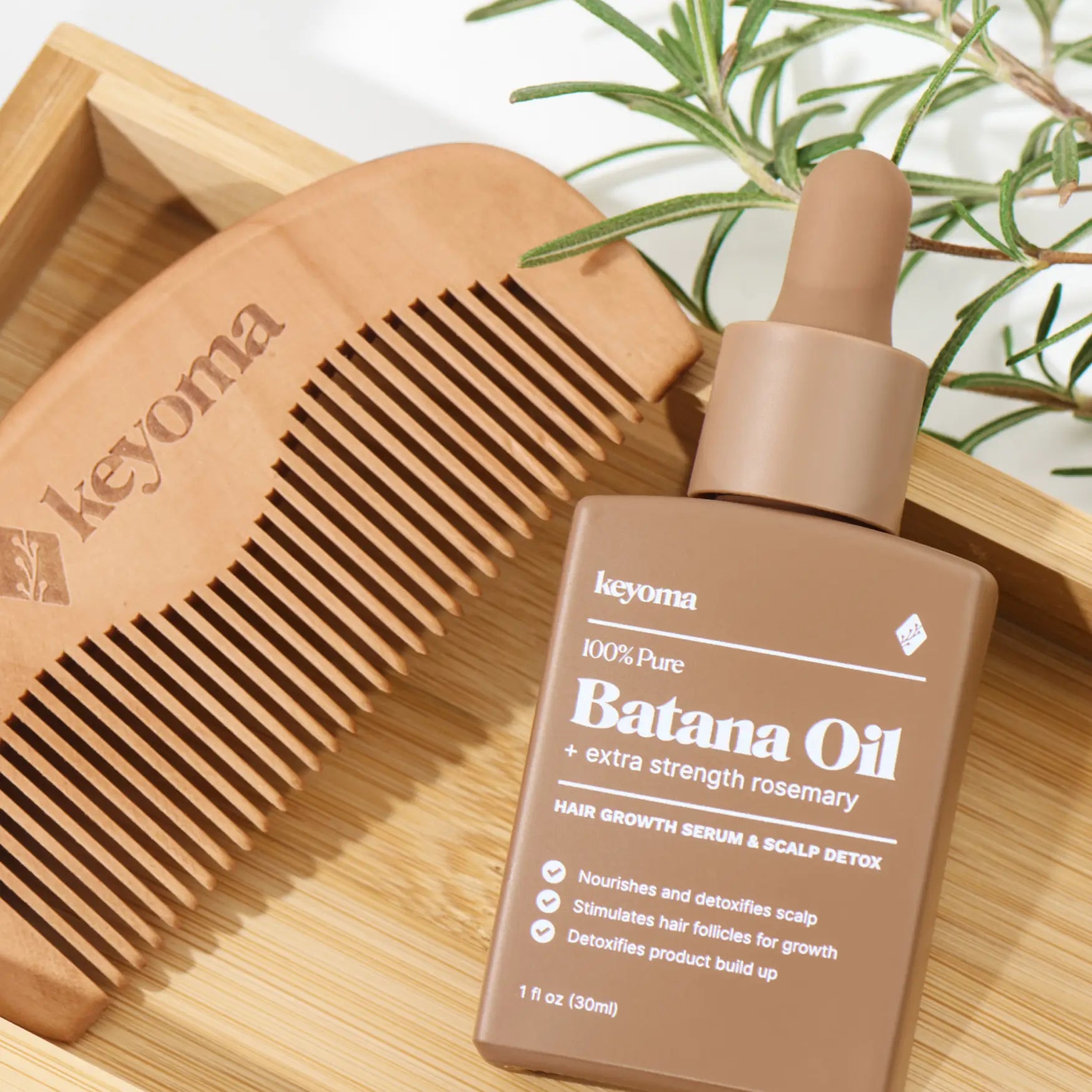
Keyoma’s Pure Batana Oil & Rosemary Oil formula is designed as a streamlined hair and scalp oil. However, it should only be considered after the reaction has completely resolved and if its ingredients are appropriate for you. If you reacted to this formula, rosemary oil, or another listed ingredient, do not retry it without medical guidance.
Stop immediately if burning or stinging returns. A product does not become a better match simply because you apply less of it or dilute it without knowing which ingredient caused the problem.
Burning Is a Stop Signal, Not a Measure of Effectiveness
A hair oil should not require you to tolerate worsening discomfort. If your scalp burns or stings, stop the application, rinse the product out gently, and avoid adding more treatments while your skin recovers.
Document what you used and how the reaction developed. Contact a healthcare professional if symptoms persist, worsen, spread, or return with another exposure. Seek prompt or emergency care when severe warning signs appear.
The goal is not to prove whether the oil caused an allergy at home. It is to protect your scalp, avoid another exposure, and get the right level of help when the reaction goes beyond mild, temporary discomfort.
Featured Product
30% Off + 3 FREE Gifts
100% Pure Batana Oil + Rosemary


