

In this article
Heatless curls can look defined when you first release them, then quickly turn flat or frizzy as you begin separating each section. A small amount of batana oil can soften dry ends and help your fingers glide through the curls with less rough handling. The challenge is using enough to improve the finish without weighing down the shape you worked to create.
Timing matters just as much as the amount. Batana oil works best as a controlled takedown or finishing step, not as a heavy treatment before wrapping your hair. Wait until your hair is fully dry, release the curls, and assess what they actually need before adding oil.
Key Takeaways
-
Apply batana oil during or after takedown rather than heavily coating your hair before setting it.
-
Spread a tiny amount across your hands until they look nearly dry, then touch the ends first.
-
Keep oil away from the roots if lift, volume, and longer-lasting definition are your priorities.
-
Use clean fingers at the crown and lightly oiled fingertips only where the curls need softness or separation.
Can You Use Batana Oil on Heatless Curls?
You can use batana oil for heatless curls, but it should support the finish rather than create the curl itself. Oil does not provide the hold of a mousse, foam, or setting lotion. Its more useful role is adding softness, slip, and shine to areas that feel dry after the curl set comes down.
Batana oil has a richer texture than many lightweight finishing serums. That can work well for dry, coarse, or high-density hair, but it also leaves less room for overapplication. Fine or easily weighed-down hair may only need the thin residue left on your fingertips after you rub the oil between your palms.
The right stage depends on what you want from the style:
|
Routine Stage |
How to Use Batana Oil |
|
Before wrapping |
Usually skip it or use an exceptionally small amount on very dry ends |
|
During takedown |
Use lightly coated fingertips to reduce rough separation |
|
After separation |
Touch up individual ends or outer strands that still appear dry |
|
At the roots |
Avoid oil when preserving lift and volume is the priority |
If your hair already feels smooth when you release the curlers, you may not need oil at all. Adding a product simply because it is part of the routine can turn an already balanced curl set into a coated one.
How to Apply Batana Oil Without Flattening Heatless Curls
The safest approach is to separate the takedown into stages. Release the curls first, observe how they fall, and only then decide where oil would improve the result.
Make Sure Your Hair Is Fully Dry
Do not use oil to disguise a curl set that is still damp. Hair released too early may stretch, lose definition, or develop uneven sections regardless of the finishing product you apply.
Before removing your heatless curler, check the hair closest to the scalp, the center of the thickest wrapped sections, and the ends tucked underneath. If any area feels cool or damp, give it more time.
The American Academy of Dermatology recommends allowing hair to air-dry when possible and handling wet hair carefully because it can be more vulnerable to breakage. Hair texture matters, so follow a detangling method appropriate for your curl pattern. During takedown, the practical goal is to avoid unnecessary pulling, brushing, and repeated manipulation.
Unwrap Before You Separate
Remove any clips, ties, or scrunchies without pulling against the hair. Unwind each section in the same direction it was wrapped instead of dragging the curler straight out.
Once every section is released, let the curls fall naturally for a few minutes. Fresh heatless curls may look tighter than expected at first, but they can relax under their own weight. Separating them immediately may create more frizz or volume than you intended.
At this point, your hands should still be clean and free of oil. This allows you to evaluate the curl set before changing its texture or shine.
Start With a Residual-Film Amount
Instead of measuring a universal number of drops, use the appearance of your hands to control the dose.
Place the smallest amount you can dispense into one palm or on a fingertip. Rub your palms and fingers together thoroughly. By the time you touch your hair, your hands should look almost dry. If you can see wet streaks or concentrated patches of oil, continue spreading it or remove some before proceeding.
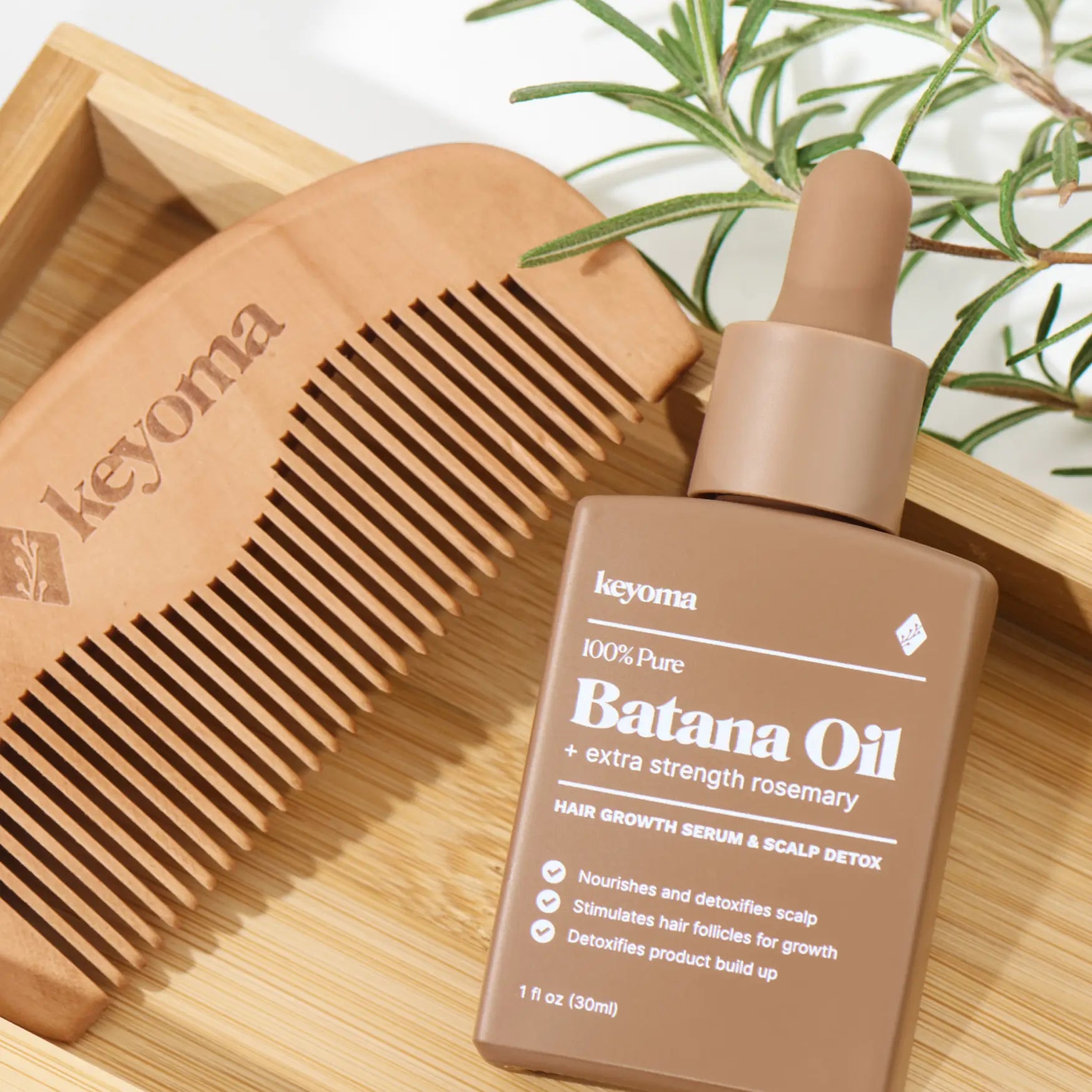
This residual-film method is especially useful with a rich product such as Keyoma Pure Batana Oil and Rosemary Oil. It lets you use the oil as a precise finisher rather than coating every curl.
Touch the driest ends first. Then use whatever remains on your fingertips to smooth selected outer strands. Do not return to the bottle until you have finished one full pass and assessed the result.
You can always add a little more. Once the curls become greasy or heavy, removing the excess without disturbing the style is difficult.
Separate the Curls From the Ends Up
Decide how much separation your style needs. Keeping larger curl clumps intact can preserve definition and hold, while dividing them into smaller sections creates a softer, fuller finish.
Use lightly coated fingertips to split one curl at a time, beginning at the ends. Follow the natural divisions in the curl instead of forcing it into several equal pieces. Stop before reaching the root if you want to retain lift at the crown.
For more root volume, switch back to clean, oil-free fingers. Slide them gently under the roots and lift or shake the hair without raking through the finished lengths.
This division of labor matters: oiled fingers soften and separate dry ends, while clean fingers protect volume at the roots.
How Much Batana Oil Should You Use?
Hair length alone cannot determine the correct amount. Strand thickness, density, dryness, previous conditioning, porosity, and the styling products already in your hair all affect how much oil the finished curls can carry.
Your curls will show you whether the dose is working:
|
What You Notice |
What It May Mean |
What to Do |
|
Curls remain soft, separated, and mobile |
The amount is likely enough |
Stop adding oil |
|
Ends feel rough while the crown retains volume |
Placement is good, but some ends may need more |
Use only the residue from one fingertip |
|
Curl groups begin looking stringy |
Too much oil or separation |
Stop manipulating the curls |
|
The crown loses lift |
Oil was applied too high |
Keep future applications below the mid-lengths |
|
Hair looks shiny but feels coated |
The hair received more than it could carry |
Use less during the next takedown |
The best stopping point is when the dry areas look polished but the curls still move freely. More shine is not always a better finish, especially if the extra oil causes the curl groups to collapse into heavy sections.
If flatness happens regularly, review the broader signs that hair oil may be too heavy for your hair. The problem may be the amount, placement, timing, or number of products in the routine rather than the oil alone.
Adjust the Finish to Your Hair and Curl Goals
The same batana oil curl-finishing method will not produce an identical result on every head of hair. Start small, then adjust according to your hair and the finish you want.
Fine or Easily Flattened Hair
Release and observe the curls with clean hands first. If they already look smooth, skip the oil. If the ends appear dry, apply only the faint residue left on your fingertips and keep it below the mid-lengths.
Avoid smoothing both palms over the surface of the hair. That technique can distribute oil too close to the crown and compress the curl pattern. Targeting individual ends offers much more control.
Thick, Coarse, or Very Dry Hair
Thicker or drier hair may tolerate more oil, but that does not mean it needs a generous first application. Begin with the same residual-film amount and work in sections.
Add a second small application only if some sections remain visibly dry after the first pass. Treat those individual curls rather than glazing the entire head. This produces more even softness without making the already-balanced sections heavy.
Maximum Hold or Softer Separation
If maximum hold is your priority, separate fewer curls and use little or no oil. Preserve larger curl clumps and avoid repeatedly touching the style.
For a softer, fuller finish, coat your fingertips lightly and divide selected curls. You can also smooth the outermost strands for shine without applying oil throughout the entire set.
There is a tradeoff between fullness and hold. Every curl you separate becomes lighter and airier, but it may also lose some of its original structure. Batana oil can make the separation feel smoother, but it cannot replace a styling product designed to provide hold.
What to Do If Batana Oil Flattens Your Curls
Stop as soon as the curls begin to look stringy, coated, or less mobile. Adding dry shampoo, mousse, or another finisher immediately can create more buildup without restoring the original curl shape.
Keep your hands clean and gently lift the roots. Do not brush the hair or rake the oil from the crown toward the ends, since either action can break apart the remaining definition.
If only a few ends look oily, lightly press them with a clean, dry cloth. Avoid rubbing, which can create frizz. Then let the style settle before deciding whether it needs further adjustment.
A heavily coated set may not return to its original definition that day. In that case, wearing it as a softer wave is often more realistic than repeatedly manipulating it. Cleanse your hair during your normal wash routine, then reduce the finishing amount next time.
When to Skip Batana Oil as a Curl Finisher
Batana oil does not need to appear in every heatless-curl routine. Skip it when:
-
Your hair already feels coated or heavily conditioned.
-
You used several leave-ins and styling products before creating the set.
-
Your roots become greasy easily.
-
You need maximum hold for a long day or event.
-
The curls already look soft and polished after takedown.
-
A previous finishing application made your hair limp.
-
The product causes itching, burning, or redness.
When using a new hair product, review its ingredient list and test a small amount first. Stop using it if irritation develops. Natural ingredients can still cause individual sensitivities.
Keep the Curl, Not the Extra Oil
The best way to use batana oil for heatless curls is with restraint. Let your hair dry completely, release every section before separating it, and spread the oil until your hands look almost dry. Finish the driest ends first and keep your roots clean when volume matters.
For curls that need extra softness or shine, explore Keyoma Pure Batana Oil and Rosemary Oil as a controlled finishing option. Begin with less than you think you need and allow the curl pattern to remain the focus.
Frequently Asked Questions
Can I put batana oil on my hair before making heatless curls?
You can apply a tiny amount to very dry ends, but a rich pre-set application may weigh down the hair and interfere with drying or hold. Applying batana oil during takedown gives you more control.
Should I apply batana oil before or after taking out heatless curls?
Apply batana oil during separation or immediately after takedown, once the hair is fully dry. This allows you to target dry sections without coating the entire curl set.
Does batana oil help heatless curls last longer?
Batana oil does not provide styling hold or guarantee that curls will last longer. A small amount may soften dry ends, but too much can cause the curls to fall faster.
How do I keep heatless curls soft without losing volume?
Use a residual amount of oil on the ends, separate only the curls that need it, and keep the roots free from oil. Lift the crown with clean fingers instead of coating it.
What should I do if oil makes my heatless curls look greasy?
Stop adding products and avoid brushing or raking through the curls. Gently lift the roots with clean hands, use less oil next time, and keep the application lower on the hair.
Featured Product
30% Off + 3 FREE Gifts
100% Pure Batana Oil + Rosemary


