

In this article
Batana oil can work as a pre-wash treatment or a finishing step for permed hair. The right placement depends on where your hair feels dry, how easily your curls lose volume, and how many products are already in your routine.
Choose a pre-wash application when dryness affects most of your hair or oil tends to flatten your curls. Use it as a finishing step when only your ends need extra softness, shine, or frizz control.
This guidance is for an established perm. If you recently had your hair permed, follow your stylist’s instructions about when to wash, condition, or add styling products. Introducing oil too soon may interfere with the aftercare plan designed for your specific perm service.
Key Takeaways
-
Batana oil supports softness but cannot reverse structural changes caused by perming.
-
Pre-wash application suits widespread dryness and helps prevent heavy-looking curls.
-
A finishing application works best for rough ends, frizz, and reduced shine.
-
Start with a small amount and adjust according to buildup and curl response.
What Batana Oil Can and Cannot Do for Permed Hair
Perming changes the structure of your hair to create a lasting curl or wave. That chemical process may leave the strands drier, rougher, or more sensitive to friction than they felt before.
Batana oil coats the surface of the hair. This added lubrication may help dry sections feel smoother, reduce friction during handling, and give dull ends a more polished appearance. It can also help reduce the visible frizz that develops when individual strands separate from the curl.
However, surface care and structural repair are not the same thing.
Batana oil does not rebuild or rearrange the chemical bonds altered during the perming process. It also cannot permanently repair split ends or return severely processed strands to their original condition. If your hair snaps easily, feels unusually gummy when wet, or has lost its shape after repeated chemical services, learn the signs of overprocessed hair before adding more products.
Oil should support your conditioning routine, not replace it. The American Academy of Dermatology recommends using a moisturizing conditioner after shampooing and handling fragile hair gently. It also advises avoiding heated oil treatments when hair is already vulnerable to damage. AAD hair-care guidance
Choose a Pre-Wash Treatment for Overall Dryness
A pre-wash treatment gives you broader coverage without leaving the entire application on your finished curls.
This method is a strong starting point when:
-
Dryness extends through most of your mid-lengths and ends
-
Your curls feel rough but become flat when oil stays on them
-
Your post-wash routine already includes leave-in conditioner, mousse, gel, or curl cream
-
Your strands are fine or your perm has a loose curl pattern
-
You want the softening effect of oil with less residual coating
Because the oil is later shampooed out, you have more room to distribute it through dry areas. This does not mean saturating your hair. Too much oil may require more shampoo to remove, which works against the goal of a gentle routine.
How to Apply Batana Oil Before Washing
Use this simple routine:
-
Begin with dry hair before shampooing.
-
Separate your hair into a few manageable sections.
-
Place a small amount of oil in your palms.
-
Rub your palms together to spread the oil without heating it.
-
Smooth it over the mid-lengths and ends.
-
Leave it on briefly based on the product directions and your hair’s response.
-
Shampoo gently, then apply a moisturizing conditioner.
-
Detangle with minimal tension before styling your curls.
Keep the first application light. The hair should feel coated enough for even distribution, not soaked.
An overnight treatment is not necessary as your default. A longer application also does not guarantee softer hair. If it forces you to shampoo more aggressively the next morning, the routine has become counterproductive.
Avoid warming the oil in a microwave, hot-water bath, or heated cap. The goal is surface lubrication, not heat exposure. This matters when permed hair already feels fragile.
Adjust the Amount by Curl Density and Strand Thickness
A tighter curl pattern does not automatically need more oil.
The amount your hair can carry depends on several features working together:
-
Strand thickness
-
Overall density
-
Hair length
-
Existing product layers
-
The amount of volume you want to preserve
-
How quickly your curls start to feel coated
Fine, dense hair can look full while each individual strand remains easy to weigh down. Thick strands may tolerate more oil, even when the overall density is lower. This is why curl appearance alone is not a reliable guide.
Start with less than you think you need. After washing and conditioning, observe whether your curls feel softer without looking limp. Increase the next application slightly only if the lengths remain rough.
Use Batana Oil as a Finishing Step for Dry Ends

A finishing application makes more sense when your routine already manages most of your hair, but the ends still look rough or dry.
Consider this method when:
-
Your mid-lengths feel soft while the ends remain coarse
-
Finished curls need a small amount of shine or frizz control
-
Your hair has already been conditioned and styled
-
You need targeted support between wash days
-
Your curl pattern remains defined under light product layers
The advantage is precision. Instead of coating every curl, you place the oil where weathering, friction, and splitting tend to be most visible.
Oil may make damaged ends look smoother, but it does not fuse a split strand back together. A trim remains the only way to remove an existing split. You can learn how different types of oil support dry, splitting ends without treating them as permanent repair products.
How to Finish Permed Hair Without Flattening the Curls
Apply the oil after your hair is dry or nearly dry:
-
Place a minimal amount on your fingertips or palms.
-
Rub your hands together until the oil forms a thin layer.
-
Press or lightly scrunch it onto the rough ends.
-
Avoid repeatedly raking your fingers through finished curls.
-
Stop when the ends feel smoother, before they look visibly coated.
If you style with gel or mousse, allow the curl cast to dry first. You can then use a trace of oil while gently scrunching any areas that feel too firm.
Oil is not required every time you soften a gel cast. Try clean, dry hands first. Add oil only when the ends also need lubrication or extra polish.
Use These Signs to Decide Between the Two Methods
The best method is the one that addresses the dry area without adding an unnecessary layer everywhere else.
|
Hair signal |
Better starting method |
Reason |
|
Dryness through most lengths |
Pre-wash |
Gives broad coverage that is later cleansed |
|
Rough ends only |
Finishing step |
Targets the driest area without coating every curl |
|
Fine curls lose volume easily |
Pre-wash |
Leaves less oil on finished hair |
|
Thick curls remain dry after styling |
Finishing step |
Adds targeted softness after conditioning |
|
Hair feels sticky, dull, or coated |
Pause both methods |
The hair may need cleansing before another layer |
|
Scalp becomes greasy or irritated |
Ends-only or pause use |
Avoids adding more product to the scalp |
These signals are starting points, not rigid rules. Weather, styling friction, wash frequency, and your other products all affect the result.
Test one placement for a few wash cycles before changing the amount or method. If you introduce a new oil, conditioner, gel, and drying technique at the same time, you will not know which change helped or weighed down your curls.
Prevent Buildup in a Permed-Hair Routine

Dryness does not always mean your hair needs another layer of oil.
A routine may already include rinse-out conditioner, leave-in conditioner, curl cream, mousse, gel, and a finishing product. Each layer adds to the total product load. Adding oil every day can make curls look dull or limp, even when the individual products work well on their own.
Watch for changes such as:
-
Curls losing their usual spring
-
Hair feeling sticky after it dries
-
A dull or waxy appearance
-
Longer drying time
-
Flakes or visible residue from layered products
-
Hair feeling coated while the ends still seem rough
These are common signs of product buildup, but roughness alone does not confirm buildup. Dry weather, friction, chemical processing, and delayed trims may create a similar feel.
The AAD notes that people who regularly use creams, oils, gels, or pomades may need a clarifying shampoo before their usual moisturizing shampoo. AAD curly-hair care guidance
Clarifying is not a reason to strip your hair repeatedly. Use it according to the product directions and follow with appropriate conditioning care. If your curls regain movement after cleansing, reduce the number or amount of leave-in layers instead of immediately rebuilding the same product load.
Keep finishing oil away from your scalp when your goal is dry-end care. Applying more oil at the roots will not improve the ends, and scalp layering may contribute to residue or irritation.
Build Batana Oil Into a Safer Permed-Hair Routine
Batana oil works best as one supporting step within a complete routine.
Start with the basics:
-
Follow your stylist’s immediate post-perm instructions.
-
Wash with a gentle shampoo suited to your scalp and styling routine.
-
Apply a moisturizing rinse-out conditioner.
-
Add leave-in conditioner to dry areas when needed.
-
Detangle slowly with minimal pulling.
-
Limit unnecessary heat.
-
Use a labeled heat protectant whenever heat styling is required.
-
Choose either a pre-wash oil treatment or a targeted finishing layer.
-
Reduce the amount if your curls become heavy, dull, or coated.
The AAD identifies permed hair as one type that may benefit from leave-in conditioner. Its dermatologists recommend using the smallest effective amount and concentrating it on dry, brittle, frizzy, or tangled areas rather than the scalp. AAD leave-in conditioner guidance
Leave-in conditioner and oil do different jobs. Conditioner delivers a formulated combination of conditioning ingredients, while oil mainly helps lubricate and coat the strand. If your permed hair needs deeper conditioning, compare a hair mask and deep conditioner before replacing either one with more oil.
Choose the Batana Oil Step Your Curls Need
Use batana oil before washing when dryness affects most of your hair or your curls lose volume under leave-in oils. This gives the lengths broader contact while allowing you to cleanse away the excess.
Choose a minimal finishing application when your conditioned curls look defined but the ends still feel rough. Spread the oil thinly, press it onto the driest areas, and stop before the curls look coated.
Change one part of your routine at a time. Your hair’s response will tell you more than the size or tightness of the curl alone.
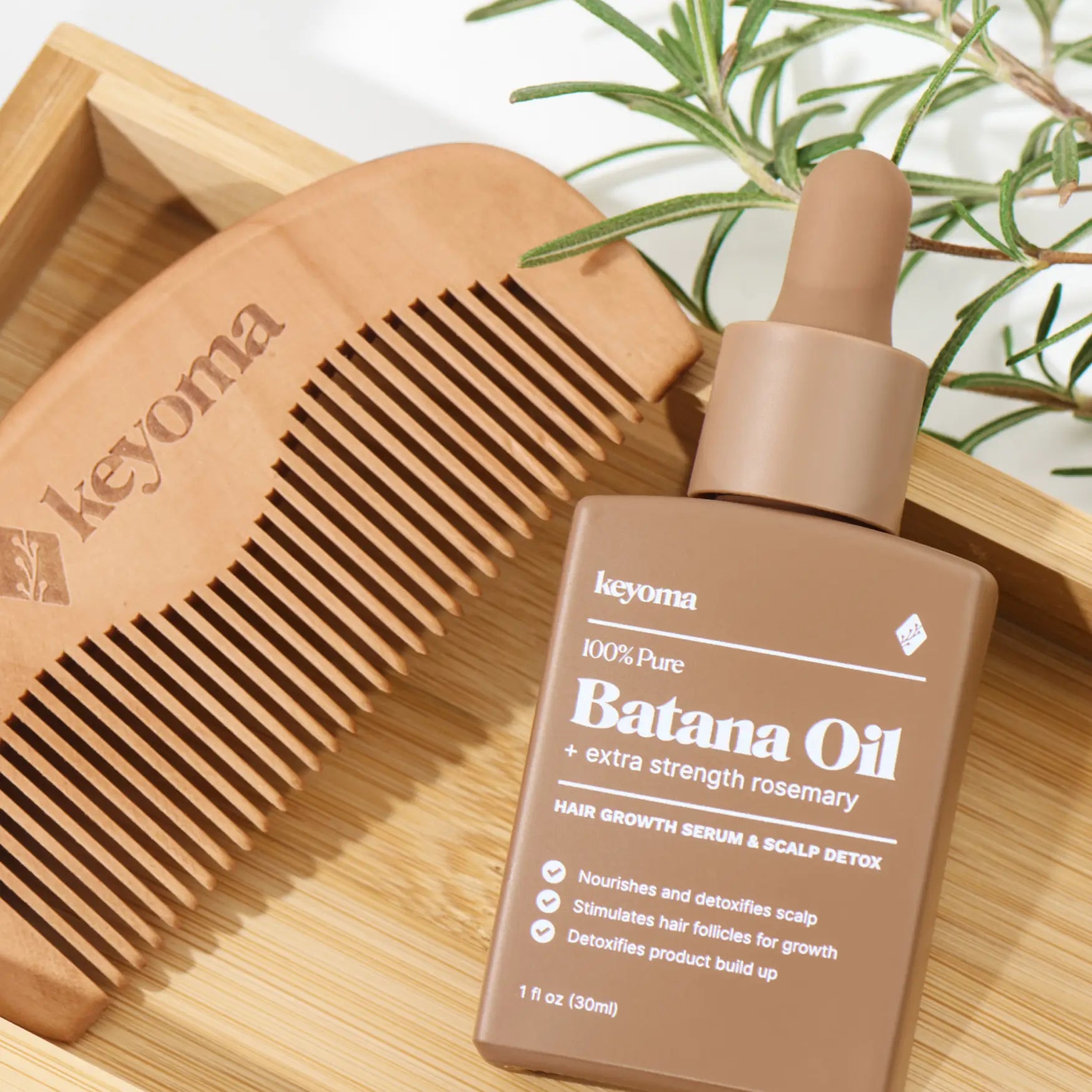
If you want to add batana oil to your permed-hair routine, Keyoma Pure Batana Oil with Rosemary can be used as a measured pre-wash treatment or a light finishing layer. It supports softness and smoother-looking ends, but it does not repair the perm or reverse chemical damage.
Featured Product
30% Off + 3 FREE Gifts
100% Pure Batana Oil + Rosemary


