

In this article
A hair stretch test shows how a strand responds to gentle tension. Does it extend slightly and pull back? Does it snap before moving much? Or does it keep stretching without returning to its earlier length?
These differences can offer useful clues about flexibility and accumulated damage. However, a strand cannot tell you exactly which product or ingredient your hair needs.
Water content, bleach, heat, friction, buildup, strand thickness, and natural variation can all change the result. This is why a good hair stretch test compares several clean strands under similar conditions instead of treating one broken hair as a diagnosis.
Key Takeaways
-
Test several clean, wet strands instead of relying on a single hair.
-
Recovery after stretching matters as much as the distance a strand travels.
-
Snapping and overstretching can have several causes beyond protein or moisture.
-
Use the result to guide one small routine change at a time.
What the Hair Stretch Test Can Tell You
Hair elasticity describes a strand’s ability to extend under tension and recover after that tension stops. It is one part of how hair behaves, not a complete measure of its condition.
An at-home hair elasticity test can help you observe:
-
How readily a wet strand extends
-
Whether it moves back toward its previous length
-
Whether it remains elongated
-
Whether it breaks before much movement occurs
-
Whether the roots, mid-lengths, and ends behave differently
The recovery stage deserves close attention. Two hairs may stretch a similar distance, but the strand that remains elongated is behaving differently from the strand that draws back.
Repeated weak results may support your concern that the hair has accumulated damage. They do not reveal the precise location or chemical cause of that damage. Laboratory researchers use controlled equipment to measure properties such as tensile strength and elastic behavior. Fingers, water, and a few shed strands cannot provide that level of precision.
How to Perform a Hair Stretch Test

The value of this test depends on consistency. If you compare a conditioned strand with an unconditioned one, or a dripping-wet strand with a partly dry strand, the result becomes harder to interpret.
Start With Clean, Naturally Shed Strands
Collect three to five full-length strands after washing or detangling. Use naturally shed hair instead of pulling attached strands from your scalp.
A shed strand lets you perform the test without placing more tension on already fragile hair. It also makes it easier to compare hair from different areas.
If damage appears uneven, gather strands from more than one section. Hair near the crown may have more sun exposure, while the ends have experienced years of washing, brushing, heat, and contact with clothing. A chemically processed section may behave differently from newer growth.
Look for a small bulb at one end. A full-length strand with a bulb is more consistent with shedding from the root. Short pieces without a bulb are more likely to represent breakage. Keyoma’s guide to identifying hair growth or breakage explains what those differences look like in daily life.
Wet Each Strand the Same Way
Saturate each strand with room-temperature water. Test it while wet or evenly damp, not while one section remains dry.
Water changes the mechanical behavior of the fiber. Research on the mechanical properties of damaged hair notes that hair’s elastic behavior is related to its water content. This makes a wet result unsuitable for direct comparison with a dry result.
Wet hair also needs gentle handling. It may extend more readily, but that does not make it safe to pull with force.
Do not coat the test strands with oil, gel, a mask, or heavy leave-in conditioner first. These products may add slip or change the surface feel, making it harder to distinguish the strand’s behavior from the product’s effect.
Stretch Gently and Watch the Recovery
Hold a strand between both hands, leaving a short section exposed. Apply slow, light tension. Do not jerk the hair or pull until your fingers hurt.
Watch four details:
-
How easily the strand begins to extend
-
Whether it feels rough, smooth, stiff, or gummy
-
Whether it returns after you release the tension
-
Whether it breaks, frays, or remains elongated
Stop if the strand starts to fray or requires force. The goal is to observe its response, not find its breaking limit.
Avoid universal claims that healthy hair must stretch by an exact percentage. Curl pattern, strand diameter, water level, testing length, and individual pulling pressure make those numbers unreliable at home.
How to Read Your Hair Stretch Test Results
Compare the pattern across several strands. One hair may contain a weak point, split, knot, or area of wear that does not represent the rest of your head.
|
Observed Pattern |
What It May Suggest |
What Else to Check |
|
Slight extension followed by recovery |
The strand retains useful flexibility and resilience |
Compare several strands before treating this as your baseline |
|
Breaks with little extension |
Brittleness, dryness, accumulated wear, or a weak point |
Heat use, bleaching, rough ends, splits, friction, and residue |
|
Extends but remains elongated |
Reduced recovery or structural weakness |
Chemical processing, gummy texture, limpness, and wet breakage |
|
Stretches extensively before breaking |
Significant wet-fiber weakness |
Bleach history, prolonged wet handling, and overprocessing |
|
Results vary between strands |
Localized wear or ordinary strand variation |
Compare roots, ends, hairline, crown, and processed sections |
These categories are observations, not diagnoses. Hair that snaps quickly is not automatically “protein overloaded.” Hair that stretches extensively is not proof of “moisture overload.”
The test does not determine porosity either. Porosity describes how readily hair interacts with water and products. Elasticity describes how the strand responds to tension. Damage may influence both, but they are not interchangeable measurements.
Why One Stretch Test Cannot Diagnose Protein or Moisture Needs
The online version of the protein moisture balance test often uses a simple rule: snapping means the hair needs moisture, while extensive stretching means it needs protein. Real strands do not behave that neatly.
Hair is made primarily from protein, but a stretch test cannot measure how much protein is inside it. It also cannot identify which internal bonds have changed or distinguish chemical damage from every other source of weakness.
Snapping with little extension may accompany:
-
Bleach, permanent color, relaxers, or perms
-
Repeated use of high heat
-
Rough detangling or towel drying
-
Split ends and weakened points
-
Stiff residue from styling or strengthening products
-
Dryness and insufficient conditioning
A strand that keeps stretching may reflect structural changes after processing. It may also feel unusually soft because of heavy product buildup, prolonged water exposure, or several overlapping conditioning layers.
Recent history gives the test context. Ask what happened during the previous two to four weeks. A new mask, repeated flat ironing, bleach session, tight style, clarifying wash, or change in detangling technique may explain more than the strand alone.
If the signs remain mixed, compare them with Keyoma’s broader guide to deciding whether your hair needs oil, protein, or moisture. The goal is not to assign your hair a permanent category. It is to choose one cautious change and see whether handling improves.
Match the Result to a Low-Risk Next Step

A stretch test becomes useful when it narrows your next action. It becomes less useful when it leads to a shelf full of new treatments.
If Several Strands Snap Quickly
Begin by reducing physical stress. Use conditioner consistently, detangle with enough slip, and work from the ends upward.
The American Academy of Dermatology’s guidance for damaged hair recommends limiting heat, avoiding pulling and tugging, and using conditioner after shampooing. These changes reduce avoidable stress regardless of whether the strand’s weakness came from dryness, heat, or chemical processing.
Inspect your ends for splits, white nodes, and recurring break points. If the same section keeps breaking, trimming worn ends may help prevent tangles from traveling farther up the strand.
Do not introduce a strengthening mask, deep conditioner, bond product, oil treatment, and new leave-in at the same time. If the hair improves, you will not know which change helped.
If Wet Hair Stretches and Does Not Recover
Pause bleaching, relaxing, permanent color, and high-heat styling while you assess the pattern. Return to a basic shampoo-and-conditioner routine and handle the hair carefully when wet.
When wet hair also feels gummy, mushy, or difficult to control, use the more targeted guide to gummy hair after bleaching. Chemical damage may create a mixed pattern where the hair feels rough when dry but unusually weak when wet.
A protein-containing or strengthening product may provide temporary support for some processed hair. Try one product according to its directions, then observe the next few wash days. If the hair becomes rigid, tangled, or rougher, using more is unlikely to solve the problem.
No conditioner, oil, or protein treatment can permanently reconnect a strand that has already split or snapped.
If the Results Are Inconsistent
Inconsistent results do not mean you performed the test incorrectly. Different areas often have different histories.
Older ends have experienced more friction and weathering than newer growth. The hairline may be exposed to repeated brushing or tension. One section may contain previous color while another has grown without chemical processing.
Repeat the test on your next wash day using the same number of strands and similar water conditions. Keep your routine simple between tests. Compare what changed rather than looking for a perfect result.
If the Hair Feels Rough but Does Not Appear Severely Weakened
Roughness does not always require an intensive treatment. First check whether the hair needs more conditioning, gentler handling, or less heat.
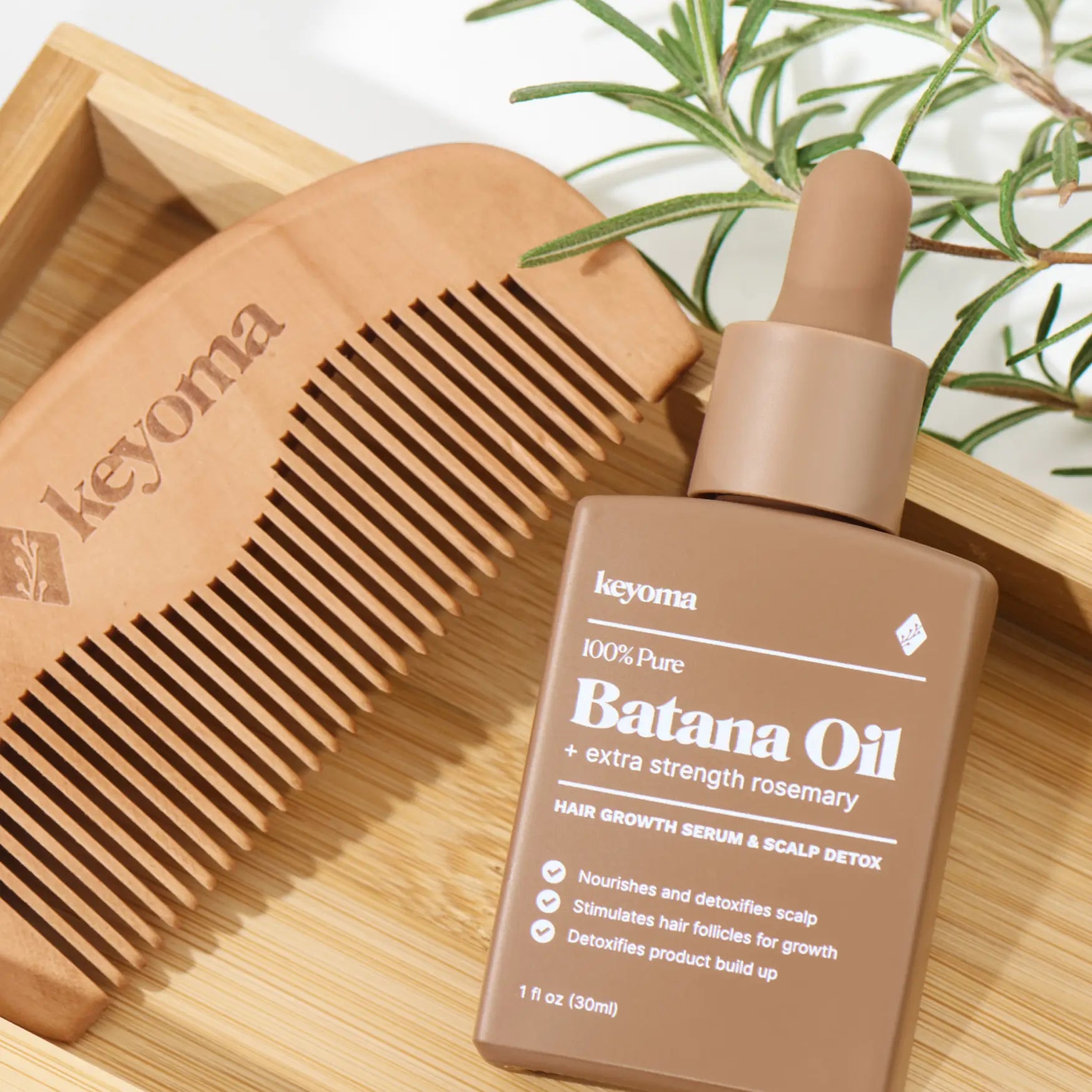
After using a water-based conditioner, a small amount of oil on the lengths can improve slip and reduce friction between strands. Keyoma Pure Batana Oil with Rosemary can serve as a light finishing step on rough ends or as a pre-wash layer when the hair tends to tangle during cleansing.
Use a small amount and keep the role of oil clear. Batana oil can help soften the feel of dry lengths and improve lubrication. It does not add water to the fiber, diagnose an elasticity issue, or reverse structural damage.
When to Stop Testing and Look Beyond the Hair Shaft
Do not repeatedly stretch fragile hairs to monitor them. Once you have identified a consistent pattern, shift your attention to how the hair behaves during washing, detangling, and styling.
A strand test cannot diagnose scalp disease, alopecia, nutritional deficiencies, or the cause of increased shedding. It only observes the behavior of the visible fiber.
Look beyond an at-home test if you notice:
-
Sudden or substantial density loss
-
A widening part or visible bald patches
-
Scalp pain, sores, burning, or inflammation
-
Large amounts of full-length shedding
-
Persistent breakage that does not improve with gentler care
-
Hair changes accompanied by other unexplained symptoms
Knowing the difference between hair breakage and hair loss can help you decide whether you are dealing with damaged lengths or hair leaving from the root. A dermatologist can assess ongoing shedding, scalp symptoms, and visible density changes that a strand test cannot explain.
Use Your First Result as a Baseline
A hair stretch test works best as a controlled comparison, not a one-time verdict.
Write down what you observed across three to five strands. Note whether they snapped early, recovered, remained elongated, or produced mixed results. Then make one low-risk adjustment, such as reducing heat, improving detangling slip, simplifying heavy product layers, or adding light lubrication to rough ends.
Retest after two or three wash days under similar conditions. Look for less snapping, easier detangling, and more consistent recovery. These daily handling improvements matter more than reaching a specific stretch distance.
Your hair does not need to pass a perfect test. The useful result is a clearer routine with fewer sources of stress and a better understanding of how your strands respond.
Featured Product
30% Off + 3 FREE Gifts
100% Pure Batana Oil + Rosemary


