

In this article
Human hair extensions can become dry, rough, or dull because they do not receive natural oils from your scalp. A small amount of batana oil can help the free-moving hair feel smoother and look more polished.
Placement matters more than coverage. Apply the oil only to dry mid-lengths and ends when the extension maker allows it. Keep it away from tape, bonds, beads, clips, wefts, lace, and other attachment areas unless your manufacturer or installer approves oil there.
Batana oil has a richer texture than many finishing oils. Instead of coating every strand, treat it as a targeted product for the sections that need help.
Key Takeaways
-
Apply batana oil only to free-moving human hair lengths and dry ends.
-
Keep oil away from attachment areas unless the manufacturer specifically permits it.
-
Start with less oil than you would use on your natural hair.
-
Stop adding oil when extensions feel smooth but still move and separate naturally.
Can You Put Batana Oil on Human Hair Extensions?
You can use batana oil on many human hair extensions if their care instructions allow natural oils. A light application may soften rough-feeling ends, reduce friction-related frizz, and add a smoother finish.
That does not mean you should apply it everywhere. Human hair compatibility and installation compatibility are separate questions. The extension hair may tolerate oil while the tape, bond, bead, clip, lace, or weft holding it in place does not.
Oil also works as a surface treatment. It can make dry extensions feel softer, but it cannot permanently repair split ends, reverse chemical damage, or replace regular conditioning. Damaged extension hair may need trimming, professional maintenance, or replacement.
Texture and density also affect the result. Thick, curly, or coarse extension hair may handle a rich oil more easily. Fine, straight, or low-density extensions can lose movement after a small amount.
Check the manufacturer's directions before applying any oil. Those instructions should take priority over general extension-care advice.
Where to Apply Batana Oil on Human Hair Extensions
The safest general target is the free-moving hair below the attachment area. Focus on sections that feel rough instead of applying oil from the top down.
Smooth a Trace Over the Mid-Lengths
Mid-lengths can become dry from washing, brushing, heat styling, clothing friction, and repeated handling. If this area feels rough, warm a trace of oil between your fingers and glide them lightly over the free-moving hair.
Start well below the installation point. Your hands should feel lightly conditioned, not wet, before they touch the extensions.
Work in sections so you can see where the oil goes. This gives you more control than rubbing it between both palms and pressing it over the entire hairstyle.
After one pass, wait several minutes. Batana oil can spread as you handle the hair, so the initial result may feel lighter than the final finish.
Concentrate on Dry or Friction-Prone Ends
The ends often need attention before the rest of the extension hair. They experience brushing, clothing friction, heat, and exposure without receiving natural scalp oils.
Place a trace of oil on your fingertips, then smooth it over the last few inches. Start with the roughest sections rather than treating every end equally.
The goal is for the ends to feel softer while remaining separate. If they gather into dark, shiny sections, you have crossed from smoothing into coating.
Oil may temporarily improve the appearance of worn ends, but it does not fuse split fibers back together. The same principle applies to natural hair, as explained in this guide to oils for dry and split ends.
Keep It Off Attachment Points
Unless the maker or installer gives different directions, keep batana oil away from:
-
Tape tabs and adhesive strips
-
Keratin or adhesive bonds
-
Beads and microlinks
-
Sewn, bonded, or beaded weft bases
-
Clip mechanisms and clip bases
-
Wig caps and topper bases
-
Lace, knots, and adhesive areas
-
Any point connecting the extensions to your natural hair
Different extension systems use different materials. Do not assume oil affects every adhesive, bond, or base in the same way. The safer rule is to protect the entire attachment area unless its official care instructions allow oil.
If an installed extension starts slipping or shifting, adding more oil will not correct it. Contact the installer before the movement places more tension on your natural hair.
Treat Leave-Out Separately
Leave-out is your natural hair, so it may have different needs from the added hair beneath it. You can smooth a small amount over dry leave-out when it helps the textures blend, but stop before reaching the installation base.
Applying more oil to make the two textures match often creates a heavy result. Use careful styling and gentle blending instead of repeatedly layering oil.
For broader guidance on exposed natural hair and added hair, see this protective styling oil routine.
Adjust the Method to the Extension Type
“Human hair extensions” covers several products and installation methods. The free-moving lengths are usually the most suitable application area, but each system needs its own boundary.
|
Extension Type |
Where to Apply Batana Oil |
Main Boundary |
|
Clip-ins |
Remove them, then smooth a trace over dry lengths or ends |
Keep oil off clips and their bases |
|
Human hair wig or topper |
Apply lightly to free-moving hair if its care instructions permit |
Avoid lace, caps, knots, adhesives, and clips |
|
Tape-ins |
Use only below the attachment zone when approved |
Keep oil away from the tape |
|
Bonded extensions |
Limit oil to free-moving lengths when approved |
Avoid bonds and nearby roots |
|
Beaded or microlink extensions |
Apply below the installed area when approved |
Avoid beads, links, and weft bases |
|
Sew-in weave |
Target exposed human hair lengths and ends |
Avoid the weft base and hidden attachment area |
Removable pieces give you more control because you can isolate the hair, examine the construction, and wash the piece separately. Installed extensions require more caution because excess oil can migrate upward through handling, brushing, or sleep.
Synthetic and blended extensions need different care. Do not apply batana oil based only on how realistic the fibers look. Use a detangler or finishing product approved for that material.
How to Apply Batana Oil Without Weighing Extensions Down
Batana oil works best on extensions when you use a micro-dose approach. The correct amount depends on the length, density, texture, and condition of the hair.
Follow these steps:
-
Read the extension maker's care instructions and confirm that oil is allowed.
-
Detangle the dry hair gently, starting at the ends and moving upward.
-
Place the smallest transferable amount of oil on clean fingertips.
-
Rub your fingertips together until the oil forms a thin film.
-
Test it on a hidden section of the free-moving hair.
-
Smooth the remaining oil over the driest mid-lengths or ends.
-
Wait several minutes before deciding whether another trace is necessary.
-
Stop when the hair feels smoother but still moves freely.
Testing a hidden section is important for light-colored, porous, or chemically processed extensions. A rich oil may change how these fibers reflect light or make a treated section appear darker until it is washed.
Do not use batana oil as a substitute for heat protectant. If you plan to curl, straighten, or blow-dry the extensions, use a separately labeled heat protectant that their manufacturer approves.
Signs You Used Too Much Batana Oil
Extensions show excess oil through changes in movement and separation. Look for these signs:
-
Individual strands gather into greasy sections
-
The hair loses volume or movement
-
The ends look wet instead of polished
-
The extension hair attracts lint or dust
-
The treated area feels coated after brushing
-
The hair looks darker in uneven sections
-
Oil begins moving toward the attachment area
-
Each new application makes the hair duller instead of smoother
A common mistake is applying more oil because the ends still look damaged. If the hair already feels coated, another layer will not repair it. It will make the existing damage harder to assess.
Repeated layering can also combine with leave-in conditioner, styling cream, heat protectant, and natural scalp oil. Review the full routine before blaming one product.
What to Do if the Extensions Feel Oily
Stop applying oil as soon as the hair feels heavy. Trying to cover the residue with dry shampoo, fragrance spray, or another styling product can make the buildup harder to remove.
Use this correction sequence:
-
Blot the free-moving lengths gently with a clean, absorbent cloth.
-
If only one section is heavy, distribute a small amount of the excess toward untreated dry ends.
-
Avoid brushing the oil upward toward the attachment points.
-
Wash removable extensions according to their official care directions.
-
Use only the approved cleansing method for installed extensions.
-
Contact your installer if oil reaches the base or the extensions begin slipping.
Do not experiment with strong clarifying products on expensive extensions without checking their care instructions. Colored or processed human hair may react differently from your natural hair.
Once the excess is removed, wait before trying oil again. The next application should use less product, cover a smaller area, or happen less often. These signs of hair oil overuse can help you recognize when a routine needs a reset.
How Often to Use Batana Oil on Extension Ends
Use the condition of the hair as your guide instead of following a daily schedule. Apply another trace only when the free-moving ends begin to feel rough and the previous product is no longer sitting on the surface.
Your ideal timing will depend on:
-
Extension density and length
-
Straight, wavy, curly, or coily texture
-
Color and chemical processing
-
Heat-styling frequency
-
Climate and humidity
-
Washing routine
-
Other leave-in products
-
Manufacturer instructions
Fine or straight pieces often need less oil and longer gaps between applications. Dense, curly, or coarse extensions may tolerate a small amount across more sections.
Frequency should decrease if the hair loses volume, forms oily sections, attracts lint, or needs more frequent washing. Extension hair does not need to look glossy to be protected.
Installed extensions also need closer monitoring. Even when you apply oil below the base, repeated handling can transfer residue upward. Leave a generous buffer between the treated hair and every attachment point.
Know When Oil Is Not the Answer
Batana oil is suited to surface-level concerns such as roughness, friction, and a dull finish. It is not the right response to every extension problem.
Contact your installer when you notice:
-
Slipping or shifting attachments
-
Matting close to the base
-
Loose beads, bonds, clips, or wefts
-
Persistent pulling or scalp tenderness
-
Broken natural hair around the installation
-
An unusual odor that remains after approved cleansing
Oil cannot make a tight or poorly fitted installation safe. The American Academy of Dermatology warns that styles which continually pull on the hair can contribute to breakage and permanent hair loss. If an installation hurts or places ongoing tension on your natural hair, reduce the tension rather than trying to soothe the area with oil.
Protect Extension Ends With a Lighter Application
Human hair extensions are an investment, so a controlled routine is more useful than a generous one. Keep batana oil on the free-moving mid-lengths and ends, protect every attachment area, and let the extension maker's directions lead your decisions.
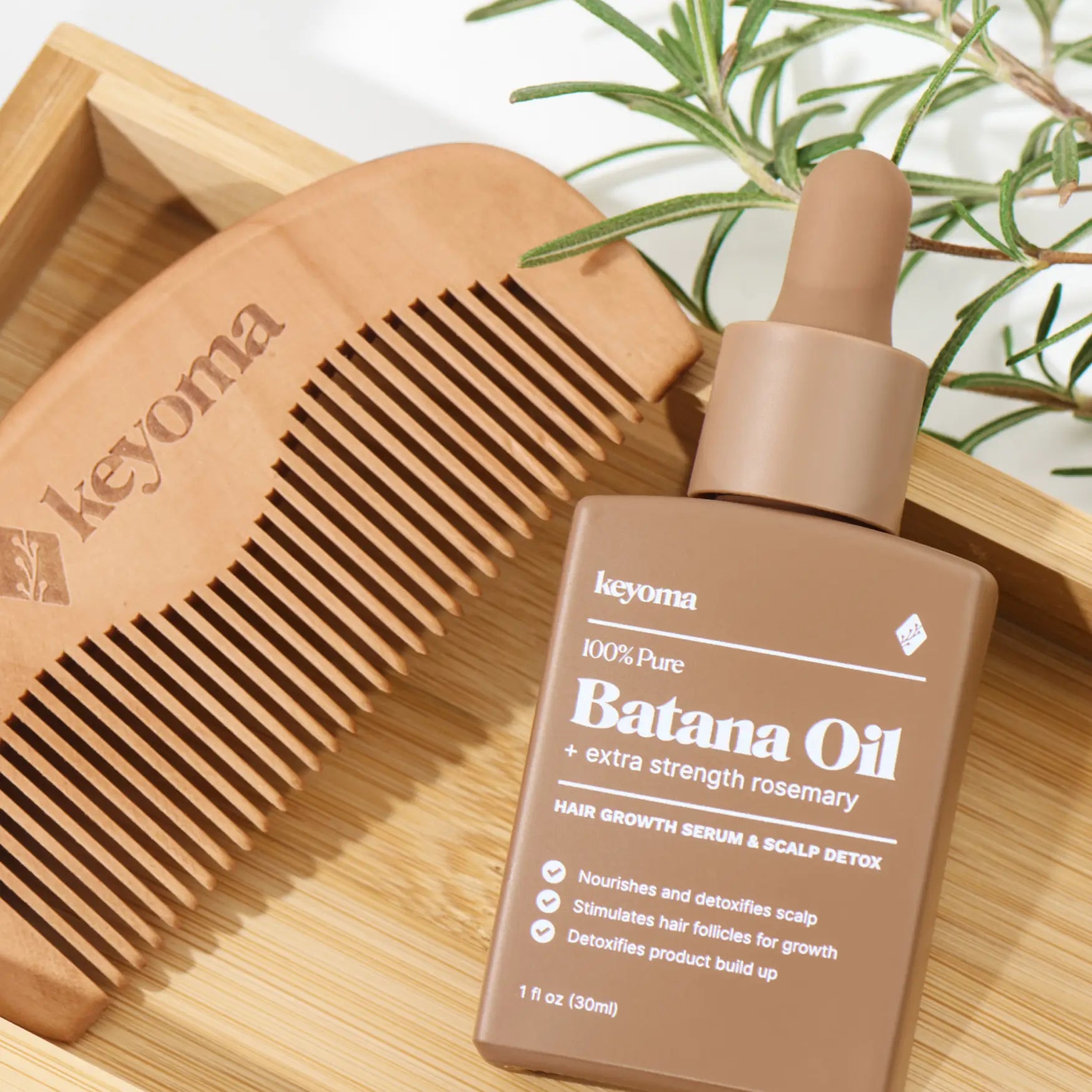
Keyoma Batana Oil with Rosemary offers a rich, concentrated option for targeted hair care. Warm the smallest amount between your fingertips, test it on one dry section, and wait before adding more.
A successful application should leave the extension hair smoother without making it look wet, flat, or separated. When the strands still move naturally, you have used enough.
Featured Product
30% Off + 3 FREE Gifts
100% Pure Batana Oil + Rosemary


