

In this article
Your relaxed ends may feel rough even when your roots already have enough product. Applying more oil everywhere makes it harder to tell which area needs attention.
When using batana oil for relaxed hair, start with a small amount on the ends after your usual conditioning routine. Assess the finish before moving higher up the lengths. Around a touch-up, follow your stylist's preparation and aftercare instructions.
Think of oil as an optional finishing step for softness and shine. It does not reverse chemical processing, repair broken bonds, or replace conditioner.
Key Takeaways
-
Start with a small amount on relaxed ends, then assess the finish.
-
Treat new growth and processed lengths as separate zones during routine care.
-
Follow your stylist's instructions around touch-ups instead of using a fixed waiting period.
-
Oil supports cosmetic softness and shine but does not reverse chemical damage.
Choose Where to Apply Batana Oil
You do not need the same amount of oil from root to tip. Previously relaxed hair and untreated new growth have different textures, while your scalp is a separate area with its own needs.
Use this placement guide when your goal is to soften the feel of processed lengths.
|
Area |
Where oil fits |
When to leave it alone |
|
Relaxed ends |
First trial area when the tips feel rough |
The ends already feel coated or stick together |
|
Relaxed mid-lengths |
Smooth leftover oil from your hands over selected rough areas |
The lengths already feel soft and move freely |
|
New growth |
Assess separately instead of extending the ends routine upward |
The only concern is its different texture |
|
Scalp |
Not required for an ends-focused routine |
Skin feels irritated, sore, or broken |
New growth is not a problem to smooth away with extra oil. If a comb catches where the two textures meet, stop pulling. Use an appropriate conditioner or detangler and work through smaller sections.
Oil also serves a different purpose from relaxer. The American Academy of Dermatology recommends that professionals apply relaxer touch-ups only to newly grown hair, avoiding previously relaxed lengths. That does not mean your everyday oil routine needs to target those same roots. AAD's guidance on Black hair care.
Apply a Small Amount to Relaxed Ends
Try a limited application between chemical services, when your scalp feels comfortable and your aftercare instructions allow your usual products. Use a formula intended for hair application and check its directions first.
There is no single amount that suits every length, density, or oil formula. The aim is to find the smallest application that improves the finish without leaving a noticeable coating.
-
Start with your usual conditioning routine: On wash day, shampoo and condition as usual. Apply your leave-in conditioner if it is part of your routine. The AAD recommends conditioner after shampooing and gentle handling for fragile hair. Oil should remain an optional addition to that foundation. AAD's tips for managing fragile hair.
-
Choose one small section: Pick an accessible section with rough-feeling ends. Keep it loose rather than stretching it taut. Starting here lets you judge the result before applying oil throughout your hair.
-
Spread a minimal amount across your hands: Put the oil on your fingertips or palms first. Spread it into a thin film, then lightly smooth it over the ends. Avoid dispensing a full dropper directly onto a small section.
-
Use the remainder only where needed: If part of the mid-length feels rough, pass your lightly coated hands over that area. Leave soft sections alone. Do not pull the oil through tangles or repeatedly rub where new growth meets processed hair.
-
Check the finish before adding more: Let the section fall naturally. It should still move freely. If the strands gather into oily pieces or leave a greasy film on your fingers, stop. More shine is not a reason to keep applying.
-
Reassess before the next application: You do not need to repeat the routine every morning. If yesterday's oil remains noticeable, skip another layer. Reduce the amount next time if the hair becomes limp or coated.
A small application on damp, conditioned ends is one option when the product directions allow it. A light touch on dry ends is another. With damp hair, wait until it dries before deciding whether the amount was enough.
For example, if only the last inch feels rough while the rest of your hair feels soft, keep the application there. You do not need to oil the full length to make the routine complete.
Adjust Oil Use Around Relaxer Touch-Ups

A routine that feels comfortable between appointments does not automatically belong in your touch-up preparation. Your stylist needs to account for the relaxer system, products already on your hair, and the condition of your scalp.
Before Your Appointment
Ask your stylist when to pause oils and leave-ins, and when they want you to wash. Share the name of the oil you use and whether you apply it to your scalp or only your ends.
A useful question is: “I use batana oil on my relaxed ends. Should I stop before this appointment, and when should I wash?”
Do not add a heavy coating because you have heard that oil protects hair during relaxing. Professional protective products and preparation steps are specific to the service. Batana oil should not replace them.
If your scalp is scratched, tender, or irritated before the appointment, tell your stylist before treatment starts.
On Touch-Up Day
Leave relaxer application, rinsing, and neutralization to your professional and the specific system's instructions. Do not mix batana oil into relaxer or apply it during processing.
Oil is not a neutralizer. It also does not make overlapping relaxer onto previously processed hair safe.
Tell your stylist what is already on your hair, even if the product was applied the day before. That gives them more useful information than adding another product at home immediately before the appointment.
After the Service
Before you leave, ask when to resume your normal leave-ins and whether that guidance differs for scalp application and ends-only use.
There is no universal batana-oil waiting period that applies to every relaxer service. A fixed 24-, 48-, or 72-hour rule ignores differences in products, aftercare instructions, and scalp condition.
Resume optional oiling in line with your aftercare guidance, with no active scalp irritation. Feeling comfortable does not override an instruction to wait.
If you develop burning, sores, or persistent discomfort, do not use oil to soothe or cover the problem. Seek appropriate medical advice. Review the signs that mean you should stop when you notice scalp redness after oiling.
Change the Routine if Hair Feels Coated or Keeps Breaking
The response to oil tells you whether to adjust the application. It does not diagnose what is happening inside the strand.
If your hair feels oily and weighed down, stop layering. Cleanse at an appropriate wash time, following any service aftercare instructions, and use less at the next application. Avoid repeated harsh washing to remove every trace of oil.
If the surface feels oily but the hair remains rough, adding more is unlikely to solve the concern. Reassess your conditioner, detangling method, and recent chemical or heat exposure. Keep the routine simple enough to notice which change helps.
Repeated snapping or visibly split ends call for a different next step. Arrange a stylist assessment and discuss trimming or changes to your routine. Our guide to care for overprocessed hair covers the broader issues beyond oil placement.
Avoid stretching strands to test their strength. If you notice hair snapping while detangling, stop pulling through resistance rather than adding oil and continuing.
For unexplained thinning or ongoing hair loss, seek a dermatologist's assessment. Oil is not a substitute for finding the cause.
Frequently Asked Questions
Can batana oil replace conditioner on relaxed hair?
No. Keep conditioner in your wash routine. Oil may improve the feel or shine of the surface, but it does not provide the same formulation or function as a conditioner. If your ends stay rough beneath an oily layer, reassess conditioning instead of increasing the oil.
Should I oil my new growth as often as my relaxed ends?
Not automatically. Your ends may need a light finishing step while your new growth needs none. Judge each area separately. If managing the two textures is difficult, focus on gentle detangling and discuss the routine with your stylist.
Can I use batana oil before flat ironing relaxed hair?
Do not use ordinary batana oil as your heat protectant. Choose a product labeled for heat protection and follow its directions. Adding oil does not make repeated heat passes safe. If you use oil for finishing, keep that purpose separate from preparing hair for a hot tool.
Start With Your Relaxed Ends
Choose one small section for your next application between services. Keep the oil on the ends, assess how the hair moves, and skip another layer while the previous one remains noticeable.
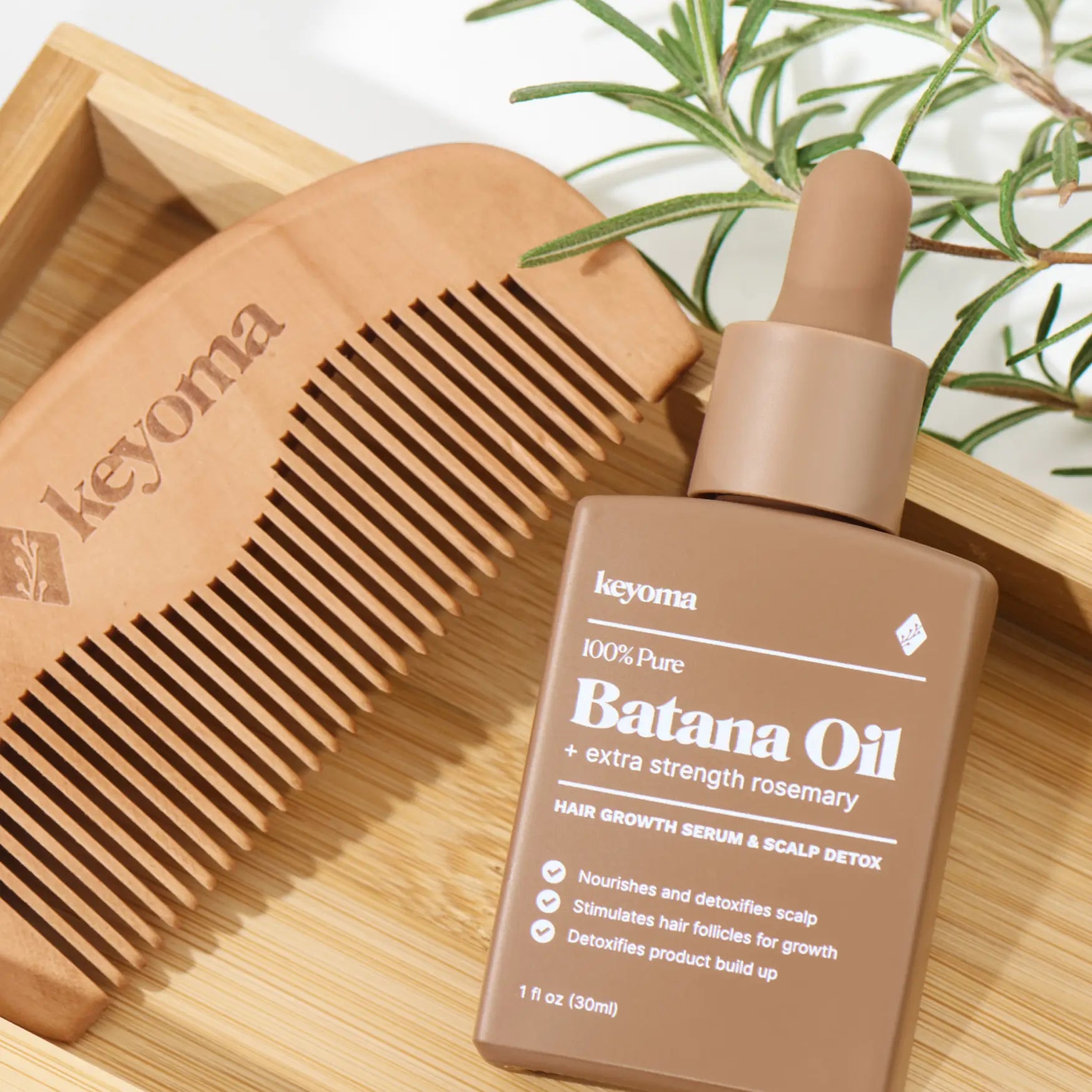
If you are considering Keyoma Batana Oil with Rosemary, check the current product directions and ask your stylist how it fits your relaxed-hair routine. The formula contains rosemary as well as batana oil, so treat it as the finished blend you are applying.
Keep your goal specific: a comfortable, lightly finished feel on the lengths. Let conditioning, gentle handling, and professional touch-up care remain the foundation.
Featured Product
30% Off + 3 FREE Gifts
100% Pure Batana Oil + Rosemary


