

In this article
Batana oil may suit mixed-porosity hair, but spreading the same amount from roots to ends often creates uneven results. Areas where products sit on the surface usually need very little oil, while rougher or more weathered sections may handle a slightly fuller coating.
Mixed porosity is not a medical diagnosis or a permanent label. It describes hair that absorbs, holds, and releases water or products differently across the head or along the same strand.
Map how each area behaves, begin with a washable pre-shampoo treatment, and adjust the next application according to softness, residue, drying time, and heaviness.
Key Takeaways
-
Apply less oil where hair becomes greasy or coated quickly.
-
Give dry, porous ends a light second pass when needed.
-
Use a pre-wash treatment first if buildup is common.
-
Adjust frequency according to results rather than a fixed schedule.
Can You Use Batana Oil on Mixed-Porosity Hair?
Yes, you can use Batana oil on mixed-porosity hair, provided you control the amount and placement. Its most realistic role is cosmetic conditioning. A thin coating may add softness and shine, improve slip, reduce friction during handling, and help fragile lengths feel less rough.
Those effects do not mean Batana oil permanently repairs the cuticle or changes natural porosity. They also do not establish hair-growth benefits. Dermatologists Melanie Palm, MD, and Brendan Camp, MD note that direct research supporting Batana oil for regrowth is lacking, although hair oils may help dry or damaged hair feel better and reduce breakage during care.
Porosity guidance should also remain oil-specific. A published study of coconut-based hair oil found benefits in tests of porosity and mechanical properties, but those findings cannot prove that Batana oil penetrates or performs the same way. Different oils have different fatty-acid profiles, structures, formulas, and testing histories.
Map Your Lower- and Higher-Porosity Zones

Start by observing sections rather than assigning one porosity type to the entire head. The general hair porosity guide can help with the basic traits, but everyday behavior offers the most useful clues for zone-based oil application.
Newer growth near the scalp may behave differently from older mids and ends. Repeated washing, brushing, heat, coloring, friction, and ultraviolet exposure can weather the hair shaft. Research on photoaging, heat damage, and bleaching shows that these exposures can disrupt the cuticle and weaken fibers.
Do not rely on a single float test as a final answer. Residue, strand diameter, prior treatments, and the section selected can influence what happens. Compare several clean strands and, more importantly, watch how separate areas respond during washing, conditioning, and styling.
Signs of Lower-Porosity Roots or Sections
A lower-porosity or easily weighed-down area may take longer to become fully wet. Conditioner or oil may remain noticeable on the surface, and the section may look flat or greasy before it feels conditioned.
Roots can also become oily for reasons unrelated to porosity, including normal scalp sebum. When the pattern includes oily roots and dry ends, avoid assuming that the scalp needs more oil simply because the lengths feel rough.
Signs of More Porous Mids and Ends
More porous sections often wet quickly, dry faster, tangle more easily, and lose their smooth feel sooner. They may look frizzy, feel rough, or develop breakage after heat, coloring, or repeated mechanical stress.
The oldest ends frequently show the most wear, but not every head follows that pattern. Highlighted face-framing pieces, a heat-styled crown, or one side exposed to more friction may need extra conditioning even when neighboring sections do not.
How Much Batana Oil Each Zone Needs
Rigid drop counts do not account for density, strand diameter, length, or formula thickness. Begin with the smallest visible amount, spread it between the palms or fingertips, and add more only where the hair remains rough.
|
Hair zone |
Starting amount |
Application goal |
Reduce the amount if |
|
Roots or crown |
Residue only |
Light surface lubrication without coating the scalp |
Roots separate into oily sections or lose volume |
|
Mid-lengths |
Light coating |
Add slip and smoothness without stiffness |
Hair feels coated after washing or dries limp |
|
Ends or damaged sections |
Light coating, then a second light pass if needed |
Cushion rough, porous areas and reduce friction |
Ends feel waxy, sticky, or difficult to cleanse |
Lower-Porosity Roots and Crown
Touching the roots with what remains on the fingertips may be enough. People prone to scalp buildup may prefer to skip the roots entirely and place oil only on the lengths. The distinction between scalp oiling and oiling the hair lengths can help separate scalp goals from cosmetic conditioning.
Medium-Porosity Mid-Lengths
Use a light, even film through the middle section. The hair should feel smoother, not saturated. If one area absorbs the oil quickly but another stays shiny, split the mid-lengths into smaller sections instead of adding more everywhere.
Porous Ends and Damaged Sections
Press a small amount onto the last few inches, then reassess. A second light pass may help porous damaged ends, especially before shampooing, but heavy layering can make even dry hair feel stiff or dirty.
How to Apply Batana Oil in a Mixed-Porosity Routine

A pre-wash method offers the easiest starting point because excess oil will be shampooed out. Leave-in use works better as a tiny, targeted finishing step for dry mids or ends than as an automatic whole-head application.
Step 1: Choose a Pre-Wash or Leave-In Method
For pre-wash use, apply oil before shampooing and leave it on long enough to spread and condition the surface. A short treatment is easier to troubleshoot than an overnight application, especially if the scalp becomes itchy or the roots collect residue.
For leave-in use, start with nearly dry or lightly damp hair and use only the film left on the hands. Keep it away from sections that collapse easily. The pre-wash versus post-wash hair oil overview can help match the method to the desired finish.
Step 2: Dampen and Section the Hair
Light dampness can make distribution easier, but the hair should not be dripping. Divide it into enough sections to reach dry areas without repeatedly coating the same strands.
Sectioning also makes uneven hair porosity easier to manage. One section may need no added oil, while another may need a second pass at the ends.
Step 3: Apply by Zone Instead of All Over
Warm a small amount between the fingers. Touch the ends first, move upward through the mids, and use only the remaining residue near the roots if that zone tolerates oil.
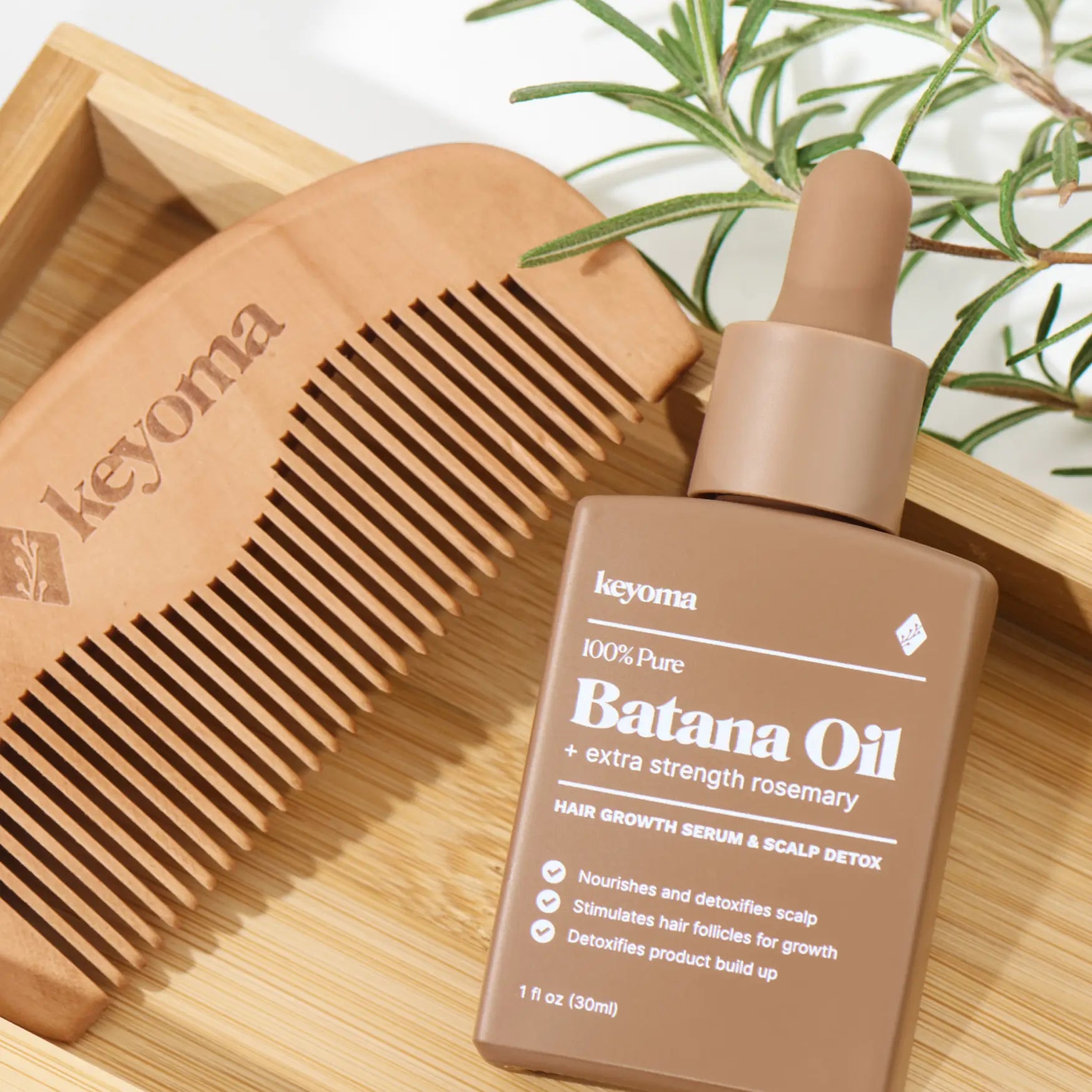
Raw, single-ingredient Batana oil and Keyoma’s serum should not be treated as identical products. The Keyoma Batana Oil + Rosemary serum contains Batana oil and rosemary.
Its published directions call for two to three drops on targeted scalp areas, gentle massage, at least 30 minutes before rinsing or overnight use, and application three to four times weekly. Follow the product directions as the baseline, then adjust distribution across the hair without exceeding what the scalp tolerates.
Step 4: Wash Out or Finish the Routine
Shampoo the scalp and let the lather move through the lengths. If the hair still feels oily, repeat a gentle cleanse rather than scrubbing the ends. Guidance on washing out thick hair oil can help when a pre-wash treatment leaves residue.
After conditioning, check each zone separately. Soft ends with light roots suggest the amount was close. Limp roots, coated mids, or ends that remain rough show where the next application should change.
How Often to Hair Oil and When to Clarify
There is no universal oiling frequency for mixed-porosity hair. Begin with an occasional pre-wash application and repeat only after observing how long the softness lasts and how easily the hair cleanses. Fine strands or buildup-prone roots may need less frequent use than coarse, weathered ends.
Track results across two or three wash cycles. Increase oil only in zones that stay rough. Reduce frequency when the hair loses volume, strands clump into greasy sections, or the scalp develops residue. A broader hair-oiling frequency guide can help refine the schedule without forcing daily use.
Clarifying may help when regular shampoo no longer removes the coated feeling, styling products stop performing normally, or the roots look dull soon after washing. Use a clarifying shampoo as needed rather than on a fixed calendar, then restore softness with conditioner focused on the mids and ends.
Balance Batana Oil for Mixed Porosity Hair and Prevent Buildup
Mixed-porosity hair responds better to flexible placement than uniform coverage. Keep lower-porosity or easily weighed-down areas nearly oil-free, give balanced mids a light film, and reserve any second pass for rough or porous ends.
Judge the routine by how the hair behaves after washing. Clean roots, smooth mids, and softer ends indicate a useful balance. Greasiness, limpness, residue, or continued roughness show which zone needs less or more at the next application.
Featured Product
30% Off + 3 FREE Gifts
100% Pure Batana Oil + Rosemary


