

In this article
Batana oil may suit thick, coarse, curly, coily, or very dry hair that responds well to rich conditioning. Olive oil is easier to find, usually easier to spread, and has some experimental evidence showing absorption into human hair fibers. Both can feel heavy when overapplied.
Neither oil can rebuild broken bonds, replace missing cuticle cells, permanently fuse split ends, or restore severely bleached hair. They can coat and lubricate strands, add shine, and make dry or damaged hair easier to handle.
The better choice depends on strand thickness, density, curl pattern, porosity, the cause of damage, the finish you prefer, how much oil you use, and whether you plan to shampoo it out. A controlled pre-wash treatment is usually easier to adjust than a heavy leave-in application.
Key Takeaways
-
Batana oil often suits hair that tolerates rich, concentrated conditioning.
-
Olive oil spreads easily and has some direct hair-fiber absorption research.
-
Either oil can weigh down fine hair or leave buildup when overapplied.
-
Both improve feel and appearance temporarily rather than permanently repairing damage.
Batana Oil vs Olive Oil: Which Is Better?
There is no universal winner in the batana oil vs olive oil comparison. Batana may be more practical when your hair is very dry, coarse, curly, or coily and tends to lose softness quickly. Olive oil may be the better option when you want a fluid, widely available oil that can be distributed across long or dense sections without warming a butter-like product first.
The evidence is also uneven. A 2005 study of oil absorption into human hair fibers found changes consistent with the absorption of olive oil into hair over time. Batana oil does not have equivalent direct research establishing how deeply it enters human hair or whether it performs better than olive oil. Absorption is not the same as reconstruction, so even the olive oil findings do not prove permanent repair.
Your hair's response is more useful than a long ingredient list. A rich oil may soften coarse ends yet leave fine strands flat. A fluid oil may spread more evenly, but that does not make it lightweight. Start with the smallest useful amount and judge the result after washing and drying.
How Batana and Olive Oil Compare
The table below describes typical forms, not fixed rules. Processing, refinement, added ingredients, and product format can change how either oil looks, spreads, and washes out.
|
Comparison Point |
Batana Oil |
Olive Oil |
|
Typical form |
May be buttery, rich, dark, or blended into a serum |
Usually fluid and easy to pour |
|
Hair feel |
Often rich and treatment-like |
Rich but generally easier to distribute |
|
Best starting use |
Controlled pre-wash application |
Pre-wash treatment on dry lengths |
|
Likely hair fit |
Thick, coarse, curly, coily, or very dry hair |
Medium to thick dry hair |
|
Fine-hair risk |
Can weigh strands down |
Can make strands flat or separated |
|
Direct hair research |
Very limited |
Some hair-fiber absorption evidence |
|
Washability |
May require careful amount control |
Can require thorough shampooing |
|
Scent and color |
Varies widely by processing and formula |
Recognizable scent and golden color |
|
Availability |
More specialized and product-dependent |
Widely available |
|
Main limitation |
Claims often exceed available evidence |
Easy to overapply and may feel greasy |
Texture, Weight, and Spreadability
Texture usually affects the routine more than nutrient marketing. Batana oil is sold in several forms, including dark, butter-like products and thinner finished blends. Trichologist Hannah Gaboardi describes traditional batana oil as thick and conditioning, which helps explain why it is often associated with thick, curly, or coily hair. A blended serum may feel very different from a raw or minimally processed balm, so the label and dispenser matter.
Olive oil stays fluid at room temperature and usually spreads with less effort. That helps on long or dense hair because you can distribute a thin film across selected sections. Too much still creates a greasy finish and reduces volume.
The best test is movement after washing. Hair should feel softer and easier to detangle without staying coated. If the ends look stringy or the roots lose lift, use less, shorten the treatment, or review the signs that hair oil is too heavy for your hair.
Hair-Fiber Absorption and Surface Coating
Hair oils can remain on the surface, move into parts of the fiber, or do both. Their behavior depends on molecular structure, application time, hair condition, and formulation. A scientific review of traditional hair oils and their functions shows why evidence for one oil should not be transferred to another.
Olive oil has direct experimental evidence consistent with some absorption into the hair fiber. Batana oil does not yet have comparable human-hair studies, so claims that it penetrates more deeply, repairs from within, or outperforms olive oil are not supported. Its fatty-acid profile alone cannot establish how a finished product behaves.
Damage adds another layer. A 2024 study on oil penetration in virgin and bleached hair found that hair condition changed how coconut, avocado, and argan oils diffused and affected mechanical properties. Batana and olive oil were not the tested oils, but the findings reinforce a broader caution: penetration does not guarantee the same benefit across every oil or damage level.
Softness, Shine, and Frizz Control
Both oils can improve softness, shine, slip, and manageability by coating the strand and reducing friction. That surface lubrication may help neighboring strands move past each other with fewer snags. It can also make rough ends look smoother for a while.
Dry-feeling hair and structurally damaged hair are related but not identical. Dryness may appear as dullness, frizz, tangling, or brittle ends. Structural damage may include cuticle loss, cracks, split ends, protein loss, and weakened areas from bleach or heat. A review of hair cosmetics and fiber damage explains how cosmetic treatments change the cuticle and cortex, while conditioners and oils mainly alter feel, appearance, and friction.
Use the phrase “damage support” rather than “repair” when judging either oil. A smoother finish can make damaged hair look healthier, but it does not restore lost structure. You can compare your symptoms with common signs of damaged hair before deciding whether oil alone is enough.
Washability, Scent, Color, and Cost
Batana products vary in scent, color, viscosity, and price. Raw versions may be darker, while refined or blended formulas can be easier to dispense. Olive oil is easier to compare by price and availability, though food-grade oil is not automatically the best cosmetic format.
Washability depends more on dose than reputation. A small amount on dry ends may rinse out easily, while a thick coating can survive one shampoo and leave the hair flat. Concentrate shampoo where the oil is heaviest, rinse well, and repeat only when residue remains. The goal is clean, flexible hair, not a squeaky finish. More detailed steps for washing out thick hair oil can help when either option lingers.
Very pale, platinum, gray, or highly porous hair deserves a strand test before using a dark batana formula. Color transfer is product-dependent, not guaranteed, but a hidden section lets you check tone, scent retention, and washout before treating the full head.
Choose Batana or Olive Oil Based on Your Hair

Hair type does not predict every result, but it gives you a sensible starting point. Strand diameter, density, porosity, previous chemical processing, and natural oiliness all affect whether a treatment feels nourishing or excessive. Your hair porosity is especially relevant because damaged or porous areas may absorb products unevenly and still feel rough if the routine lacks conditioner or other support.
Very Dry, Coarse, Curly, or Coily Hair
Both oils may work here. Batana may suit strands that tolerate rich products and ends that feel rough soon after wash day. Olive oil may be easier to spread through long, dense sections or multiple twists.
For batana, check whether the formula is solid, buttery, liquid, or blended. Warm the smallest useful amount between your palms when needed, then apply it to the driest mid-lengths and ends. Leave it on briefly before washing, shampoo thoroughly, and reduce the amount next time if your hair feels coated.
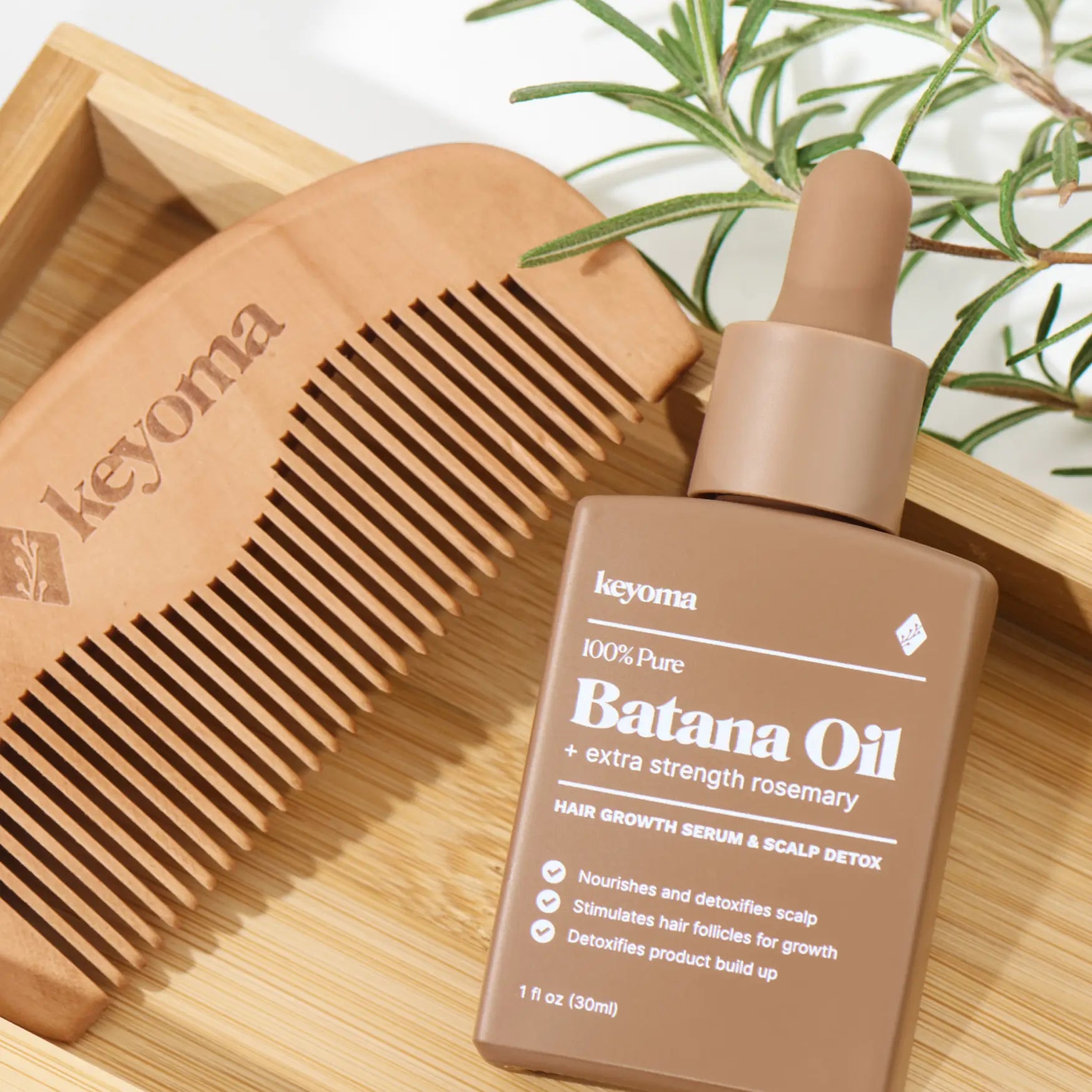
Readers who want a finished batana option can consider Keyoma Batana Oil and Rosemary Serum. It contains both batana oil and rosemary oil, so it should be treated as a two-oil serum rather than pure, single-ingredient batana oil. Patch test the formula and keep expectations focused on conditioning, shine, and manageability rather than permanent structural repair.
For olive oil, pour a very small amount into your palm instead of directly onto the hair. Spread it across both hands, press it into selected dry sections, and shampoo it out after the treatment. The full guide on how to use olive oil for hair covers its broader benefits, drawbacks, and application options.
Fine or Easily Weighed-Down Hair
Neither oil is automatically ideal as a leave-in for fine hair. Batana may feel too concentrated, while olive oil can flatten the roots and separate the ends even though it is liquid. Use either as a short pre-wash treatment and keep it below the ears or on the last few inches.
Apply less than you think you need, then stop. Adding more before the first amount has spread is a common reason fine hair becomes greasy. Avoid direct root application, shampoo the oily sections carefully, and wait until the hair is fully dry before judging the result. The practical techniques for oiling fine hair without a greasy finish also apply to both oils.
Cleveland Clinic dermatologist Dr. Shilpi Khetarpal notes that coarse, tightly curled hair may respond better to oiling than fine, straight hair. She also recommends using a small amount on dry hair and washing it out rather than assuming every scalp and hair type will benefit.
Bleached, Colored, or Heat-Damaged Hair
Bleached and heat-damaged hair often needs lower friction, easier detangling, and better control of rough ends. Either oil may help the hair feel softer and look shinier, especially when porous sections catch against each other. Oils are support products, not substitutes for conditioner, heat protectant, bond-focused treatments, appropriate protein care, or trims.
Do not rely on batana or olive oil as a heat protectant unless the finished product has been specifically tested and labeled for that use. Apply oil before washing or after styling has cooled, not as an unverified shield under hot tools. The American Academy of Dermatology recommends reducing damaging habits, such as excessive heat and rough handling, rather than trying to compensate afterward with more product.
Severely split ends need trimming because no oil can permanently fuse a divided fiber. Oil can temporarily smooth the edges and reduce snagging, but it cannot reverse the split. Review what causes split ends if they return quickly despite regular conditioning.
Oily Roots With Dry Ends
Oily roots and damaged lengths can exist at the same time. Keep both oils away from the scalp unless you have a separate, well-considered reason for applying them there. Focus on lower mid-lengths, dry ends, rough face-framing pieces, and areas exposed to the most friction.
Scalp oiling is not harmless for everyone. Cleveland Clinic advises caution because added oil may worsen seborrheic dermatitis in some people, and dermatologists reviewing batana oil recommend extra care when dandruff or scalp inflammation is present. Stop using the product if you develop persistent itching, burning, soreness, or heavy scale.
A new blend, especially one containing rosemary oil, fragrance, or other added ingredients, deserves a hair oil patch test before broader use. A patch test cannot predict every reaction, but it can reveal obvious irritation before the product covers a larger area.
Can I Use Batana and Olive Oil Together?
You can combine them, but mixing two rich oils does not automatically create a better treatment. The blend may spread more easily than butter-like batana alone, yet it can also increase the total oil load and make shampooing harder. Test each oil separately first so you know which one causes heaviness, scent concerns, or irritation.
When both work for your hair, place a small amount of the thicker product in your palm and add only enough olive oil to help it spread. Apply the blend to dry mid-lengths and ends as a pre-wash treatment. Avoid the roots, use it on selected sections rather than saturating the whole head, and shampoo thoroughly.
Do not use a universal recipe measured in tablespoons, full droppers, or fixed weekly applications. Hair length, density, strand diameter, porosity, damage level, product viscosity, and the dispenser all change the useful amount. Repeat the treatment only when the hair again feels rough or difficult to manage, not because a calendar says it is time.
Pick the Best Oil for Your Hair Needs
Choose batana oil when your hair is very dry, coarse, curly, or coily, tolerates rich conditioning, and responds well to selective pre-wash treatments. Choose olive oil when you want easier distribution, broad availability, and an oil supported by some direct hair-fiber absorption research.
Use either cautiously when your hair is fine, your roots become oily quickly, your hair is very pale or highly porous, or your routine already contains several leave-in products. Choose neither as the main answer when you need a trim, a tested heat protectant, a bond-focused treatment, or a change in the bleaching, heat, or handling that keeps causing damage.
The most useful result is not the oiliest or shiniest finish. It is hair that feels softer, detangles with less resistance, keeps its movement, and washes clean without repeated shampooing. Start small, treat the driest areas first, and let the final feel of your hair decide which oil earns a place in your routine.
Featured Product
30% Off + 3 FREE Gifts
100% Pure Batana Oil + Rosemary


