

In this article
A batana oil label can tell you a lot before you buy, but it cannot tell you everything. The front of the jar may say “pure,” “raw,” “unrefined,” or “for hair growth,” but the ingredient list gives you a clearer view of what is actually inside.
A good label helps you spot whether the product is a single oil, a blend, a fragranced formula, or a styling product built around batana oil. It can also help you avoid buying something that does not match your hair type, scalp needs, or expectations.
Still, label reading has limits. A batana oil product label can help you compare formulas, but it cannot prove authenticity with full certainty on its own. Treat the label as your first filter, then check the brand’s use instructions, transparency, safety notes, and claim style before deciding.
Key Takeaways
-
Check the ingredient list before trusting the front label.
-
Pure batana oil should usually have a short label.
-
Added oils, fragrance, and water can signal a blend.
-
A label helps you compare, but it cannot prove everything.
Why Do You Need to Know Your Batana Oil’s Ingredient Label?
Batana oil has become easier to find, but that also means buyers now see more label styles, blends, and claim-heavy products. Some formulas are simple oils. Others combine batana with rosemary, castor, coconut, fragrance, water, preservatives, or styling additives. None of those choices are automatically bad, but they should be clear.
The ingredient list matters because cosmetic ingredients are generally declared in descending order of predominance. The FDA’s cosmetics labeling guide explains that ingredients above 1% are typically listed in descending order, with special rules for ingredients at 1% or less, colors, fragrance, and flavor. If batana oil appears far down the list, the formula may contain more of other ingredients.
Ingredient declarations also help consumers compare product value. The FDA’s trade secret ingredients guidance says cosmetic ingredient declarations are meant to help shoppers compare products and make informed choices. For batana oil, that means the back label often tells you more than the marketing name on the front.
A label is especially useful when you are choosing between pure batana oil, batana blends, and batana oil with rosemary. Each option can fit a different goal, but they should not be treated as the same product.
What Should Be on a Pure Batana Oil Label?
A pure batana oil label should look simple. In most cases, you should expect one main ingredient, or a very short ingredient list that makes the formula easy to understand. If a product calls itself pure but has a long list of oils, fragrances, extracts, emulsifiers, water, or styling agents, it may be more accurate to view it as a blend.
That does not mean blends are always worse. Some people prefer a lighter texture, a scent, or an enhanced formula. The issue is clarity. A label should make it easy to understand whether you are buying batana oil by itself or a product that contains batana oil among other ingredients.
Short Ingredient List
A short ingredient list is usually the first thing to look for when a product markets itself as pure batana oil. A single-ingredient oil should not need a long supporting cast. If the label includes many plant oils, extracts, fragrance, or water-based ingredients, the product may still contain batana oil, but it is not the same as a simple pure oil.
Short labels also reduce confusion. You can more easily judge texture, use case, and possible sensitivity triggers when you are not sorting through a long ingredient panel.
Clear Batana Oil Naming
Batana oil is commonly connected with oil from the American palm, often identified with Elaeis oleifera. Formula Botanica lists the INCI name as Elaeis Oleifera Kernel Oil and describes batana oil as oil extracted from nuts of the American palm tree, native to Central and South America.
Still, you should avoid treating one exact wording as the only possible proof. Some labels may use broader palm-related naming, and ingredient naming can vary by supplier, market, and label format. A clearer label is better, but one label term alone should not be treated as a final authenticity test.
No Hidden Fragrance Claims
Fragrance is worth checking because a product can smell pleasant without listing every scent component separately. The FDA allows fragrance and flavor compounds to be declared as “fragrance” and “flavor,” though individual components may also be named.
For buyers with sensitive scalps, fragrance-free preferences, or past irritation, this matters. A label that says “fragrance,” “parfum,” “perfume,” or “natural scent” may not show every aroma compound in plain detail. If you want the simplest option, a fragrance-free or single-ingredient label is usually easier to evaluate.
No Overdone Growth Claims
A pure batana oil label should not need extreme growth claims to feel convincing. Batana oil may help dry, rough, or frizzy hair feel more conditioned, but that is different from claiming it directly stimulates new hair growth.
Byrdie’s expert-led coverage with Dr. Ava Shamban and trichologist Kimberlee Blakley frames batana oil around moisture, frizz, shine, stronger-looking strands, and the appearance of fuller hair, while noting that it is not a direct hair growth product. A label that promises fast regrowth, bald spot reversal, or guaranteed length deserves extra caution.
How to Read the Ingredient List

Reading a batana oil ingredient list is mostly about order, clarity, and consistency. You are not trying to become a cosmetic chemist. You are checking whether the formula matches the claim on the front and the way you plan to use it.
Start with the first few ingredients, then scan for added oils, fragrance, preservatives, stabilizers, and claim language. A strong label should make the formula feel easier to understand, not harder.
Check the First Ingredient
The first ingredient usually gives you the best clue about the base of the formula. If batana oil or a batana-related INCI name appears first, the formula is more likely built around batana oil. If water, mineral oil, coconut oil, castor oil, or another ingredient comes first, the formula may be a blend or a different product type.
This is not automatically a problem. A lighter blend may be better for fine hair, while a richer oil may suit coarse or dry hair. The label should simply make that choice clear.
Look for Added Oils
Added oils can change texture, weight, scent, and purpose. Castor oil may make a formula feel heavier. Coconut oil may change slip and feel. Rosemary oil changes the product from pure batana oil into an enhanced blend.
If you are comparing batana products for dry or rough lengths, a blend may still fit. For example, a broader repairing hair oil routine may focus on softness, shine, and reduced breakage from better conditioning. But if your goal is to buy pure batana oil, added oils should make you pause and reclassify the product.
Watch for Fragrance or Perfume
Fragrance terms can appear as “fragrance,” “parfum,” “perfume,” “essential oil blend,” or “natural scent.” These terms may matter if your scalp reacts easily or if you want the cleanest possible label.
A scented batana product may still be enjoyable, but fragrance can make it harder to know what you are reacting to if your scalp becomes itchy or red. Dermatologist Lauren Penzi, MD, notes in InStyle that botanical products can still cause allergy or sensitivity, including redness, scaling, or itching.
Check Preservatives or Stabilizers
Pure oils do not usually need the same preservative system as water-based cosmetics. If the ingredient list includes water, aloe juice, hydrosols, gels, or other water-based components, the formula may need preservatives or stabilizers to stay safe and usable.
That can be normal for creams, masks, conditioners, or styling products. It is less expected in a product sold as simple raw batana oil. If you see water and preservatives on the label, think of it as a formulated product, not a single oil.
What Batana Oil Ingredients Should You Expect?
The right ingredient list depends on what the product is claiming to be. A pure oil, a blend, a rosemary-enhanced formula, and a raw or unrefined oil should not all look the same.
A good buying decision starts with matching the label to the product category. Once you know which category you are looking at, it becomes easier to decide whether the formula is honest, useful, and appropriate for your hair.
Pure Batana Oil
Pure batana oil should usually be the simplest option. Look for a short ingredient list centered on batana oil, with no long chain of added oils, scent ingredients, or styling additives.
The label may use a batana-related name, a palm-kernel-related name, or a botanical INCI name. Since naming can vary, do not rely on one word alone. Look for the full pattern: short list, clear product identity, realistic claims, and use instructions that match an oil.
Batana Oil Blends
Batana oil blends contain batana oil plus other ingredients. These may include carrier oils, essential oils, fragrance, extracts, or texture modifiers. A blend can be useful when the goal is easier spreading, a lighter finish, a specific scent, or a more targeted routine.
The tradeoff is that a blend should not be marketed as the same thing as pure batana oil. If the product name says pure but the ingredient list says blend, trust the ingredient list more than the front label.
Batana Oil With Rosemary
Batana oil with rosemary is a blend or enhanced formula. It is not the same as pure batana oil. That does not make it bad, but it changes how you should evaluate the product.
A batana oil with rosemary formula may make sense if you want rosemary support without mixing essential oils yourself. This can be more convenient than DIY blending, especially because rosemary essential oil should be diluted properly before scalp use. If you are mixing your own, review how to dilute rosemary oil for hair before applying it to your scalp.
Rosemary also adds another sensitivity variable. If your scalp is reactive, compare the label carefully and review possible side effects of rosemary oil on hair before choosing a rosemary-based blend.
Raw or Unrefined Batana Oil
“Raw” and “unrefined” can sound reassuring, but they are still marketing terms unless the rest of the label supports them. A raw batana oil label should still be clear, short, and consistent with a minimally processed oil.
Do not rely only on smell, color, texture, or social media tests. Those clues can help you notice inconsistencies, but they are not proof. WebMD notes that there is no sure way to know if batana oil is real unless it is tested in a lab.
How to Choose Batana Oil Before You Buy
Choosing batana oil is not only about purity. It is also about fit. A formula can be simple and still feel too heavy for fine hair. A blend can be less pure and still work well for dry ends. The best choice depends on your goal, texture, scalp tolerance, and how much label clarity you want.
Before buying, compare the front claim, ingredient list, instructions, and safety notes. They should tell the same story. When those parts do not match, the product deserves more scrutiny.
Match the Formula to Your Goal
For dry, rough, frizzy, or dull hair, batana oil may fit well as a conditioning oil, pre-wash treatment, or end-focused finisher. Blakley and Dr. Shamban note that batana oil is rich and deeply conditioning, so very fine hair or oil-prone scalps may do better with mid-length and end application instead of direct root application.
If your ends feel dry but your roots get oily fast, consider a lighter application pattern. A page focused on hair oil for dry ends may fit that need better than a heavy scalp routine.
Check the Use Instructions
Use instructions should match the product type. A pure oil may suggest warming a small amount between your palms, applying it before washing, or smoothing a tiny amount over ends. A water-based mask or styling cream may have different directions.
If the label tells you to use a large amount daily on the scalp, but the formula is very rich, fine or oily hair may become greasy fast. I usually trust labels more when they explain amount, placement, and rinse timing clearly. You can also compare when to use oil by looking at pre-wash vs post-wash hair oil routines.
Look for Patch Test Guidance
Patch test guidance is a good sign because it shows the brand understands that natural ingredients can still irritate some people. A patch test is especially important if the formula includes fragrance, rosemary, multiple botanicals, or essential oils.
Health reports that dermatologists Melanie Palm, MD, and Brendan Camp, MD, recommend patch testing batana oil products before applying them to the scalp, face, or body, especially for people with known palm oil allergies or scalp conditions. If you notice burning, redness, itching, scaling, or swelling, stop using the product and seek medical guidance when symptoms are severe or persistent.
Review Brand Transparency
A transparent batana oil brand should make the formula easy to understand. Look for clear ingredients, realistic claims, contact information, use directions, and safety notes. Batch details, sourcing context, or testing information may also help, but do not treat marketing language as proof by itself.
Be careful with “FDA-approved” style wording on cosmetic products. The FDA says cosmetic products and ingredients generally do not require FDA approval before they go on the market, except for color additives, but cosmetics must be safe and properly labeled. Strong brands do not need to blur that line.
Avoid Labels That Feel Vague
Vague labels often rely on big promises and soft details. Watch for front-label claims that sound impressive while the back label stays unclear. Examples include “proprietary oil blend” with no useful context, “100% natural” with a long fragrance-heavy list, or “pure batana” beside several other oils.
Growth-heavy labels also need careful reading. Health notes that there is no scientific proof that batana oil regrows hair, though it may help with hydration and scalp health. A better label sets realistic expectations around moisture, shine, frizz control, softness, and the appearance of stronger hair.
Choose Batana Oil Without a Worry
A batana oil ingredient label is your first practical filter. It helps you see whether the product is pure oil, a blend, a rosemary-enhanced formula, or a more complex cosmetic product. It also helps you compare claims against what the formula actually contains.
Do not expect the label to prove everything. Use it to rule out confusing formulas, avoid vague claims, check for fragrance or added oils, and choose a product that matches your hair. A clear label, realistic claims, simple instructions, and patch test guidance usually give you a better buying signal than dramatic promises on the front of the jar.
Featured Product
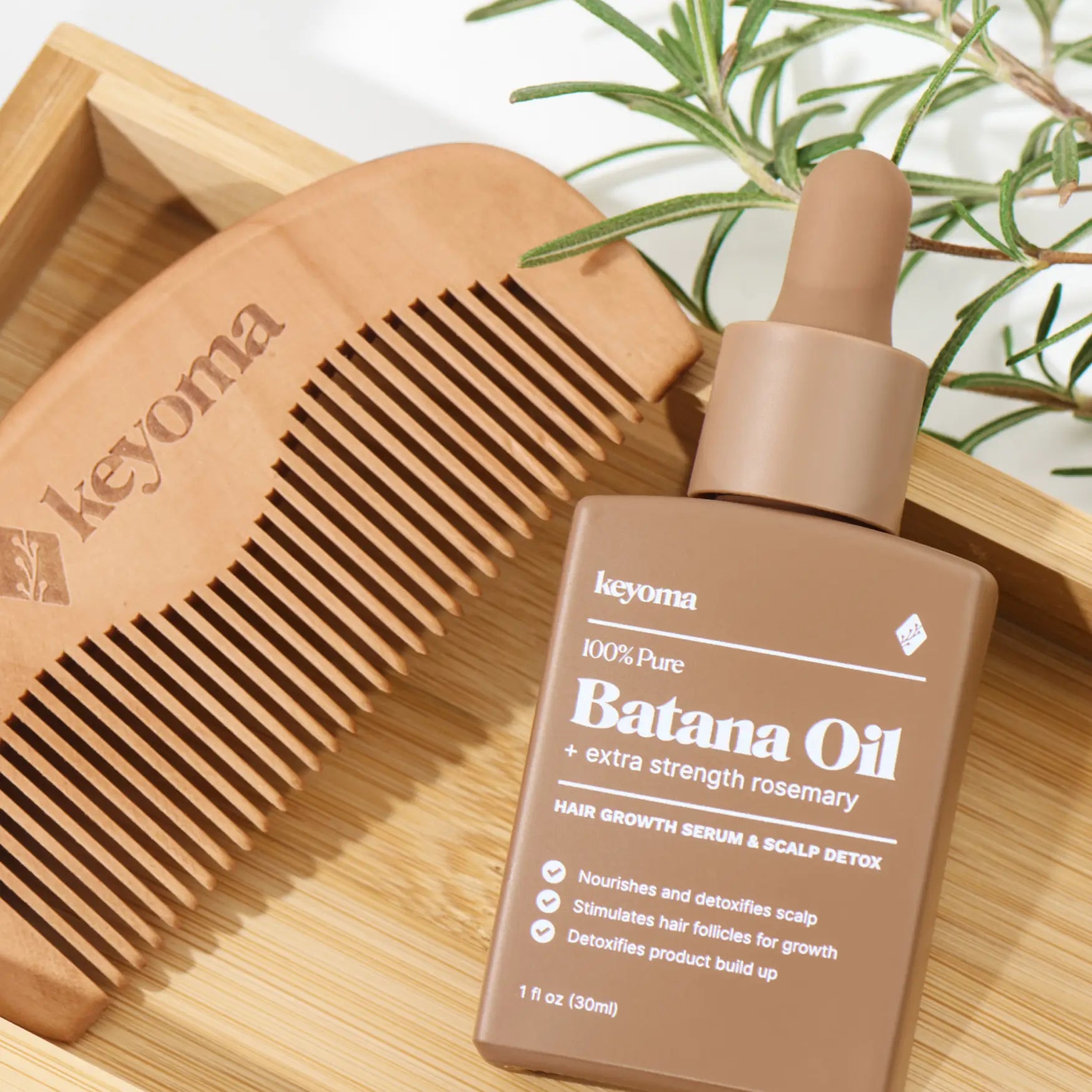
30% Off + 3 FREE Gifts
100% Pure Batana Oil + Rosemary


